ARK
MY HANDICAPPED SOLO STORIES
A PRETTY WEIRD PERSON
ASHIK RAIHAN
CREATOR
HEY GUYS SO FIRST LET ME TELL U SOMETHING IF U CAME HERE TO MEMORIZE SOMETHING THEN U CAME TO THE WRONG PLACE BUT IF U WANT TO GATHER KNOWLEDGE THEN THIS SIGHT MIGHT BE OF YOUR HELP. LET THAT KEEP ASIDE FOR A SECOND AND LET ME TELL U GUYS SOMETHING ABOUT ME. FIRST I AM A ILLITERATE WRITER. SO HELP ME TO LEARN BY EMAILING ME ABOUT ANY MISTAKES U FIND. SECOND ENJOY THE SIGHT CAUSE THE INFORMATIONS ARE NOT CRYPTIC OR CODED LIKE OTHER SIGHTS AND IF U ARE A PERCY JACKSON LOVER LIKE ME THEN THIS IS THE CORRECT PLACE TO COME.
THE GREEK MYTHOLOGGY
THE GREEK MYTHOLOGY
In ancient Greek religion and mythology, the twelve Olympians are the major deities of the Greek pantheon, commonly considered to be Zeus, Hera, Poseidon, Demeter, Athena, Apollo, Artemis, Ares, Hephaestus, Aphrodite, Hermes, and either Hestia or Dionysus.[2] They were called Olympians because, according to tradition, they resided on Mount Olympus.
Although Hades was a major ancient Greek god, and was the brother of the first generation of Olympians (Zeus, Poseidon, Hera, Demeter, and Hestia), his realm was the underworld, far from Olympus, and thus was not usually considered to be one of the Olympians.
The Olympians were a race of deities, primarily consisting of a third and fourth generation of immortal beings, worshipped as the principal gods of the Greek pantheon and so named because of their residency atop Mount Olympus. They gained their supremacy in a ten-year-long war of gods, in which Zeus led his siblings to victory over the previous generation of ruling gods, the Titans. They were a family of gods, the most important consisting of the first generation of Olympians, offspring of the Titans Cronus and Rhea: Zeus, Poseidon, Hera, Demeter and Hestia, along with the principal offspring of Zeus: Athena, Apollo, Artemis, Ares, Aphrodite,[3] Hephaestus, Hermes, and Dionysus. Although Hades was a major deity in the Greek pantheon, and was the brother of Zeus and the other first generation of Olympians, his realm was far away from Olympus in the underworld, and thus he was not usually considered to be one of the Olympians.[4] Olympic gods can be contrasted to chthonic gods[5] including Hades, by mode of sacrifice, the latter receiving sacrifices in a bothros (βόθρος, "pit") or megaron (μέγαρον, "sunken chamber")[6] rather than at an altar.
The canonical number of Olympian gods was twelve, but besides the (thirteen) principal Olympians listed above, there were many other residents of Olympus, who thus might be considered to be Olympians.[7] Heracles became a resident of Olympus after his apotheosis and married another Olympian resident Hebe.[8] According to Hesiod, the children of Styx: Zelus (Envy), Nike (Victory), Cratos (Power), and Bia (Force), "have no house apart from Zeus, nor any dwelling nor path except that wherein God leads them, but they dwell always with Zeus."[9] Some others who might be considered Olympians, include the Muses, the Graces, Iris, Dione, Eileithyia, the Horae, and Ganymede.[10]
Twelve gods
Twelve gods
Besides the twelve Olympians, there were many other various cultic groupings of twelve gods throughout ancient Greece. The earliest evidence of Greek religious practice involving twelve gods (Greek: δωδεκάθεον, dōdekátheon, from δώδεκα dōdeka, "twelve" and θεοί theoi, "gods") comes no earlier than the late sixth century BC.[11] According to Thucydides, an altar of the twelve gods was established in the agora of Athens by the archon Pisistratus (son of Hippias, and the grandson of the tyrant Pisistratus), in c. 522 BC.[12] The altar became the central point from which distances from Athens were measured and a place of supplication and refuge.[13]
Olympia apparently also had an early tradition of twelve gods.[14] The Homeric Hymn to Hermes (c. 500 BC) has the god Hermes divide a sacrifice of two cows he has stolen from Apollo, into twelve parts, on the banks of the river Alpheius (presumably at Olympia):
"Next glad-hearted Hermes dragged the rich meats he had prepared and put them on a smooth, flat stone, and divided them into twelve portions distributed by lot, making each portion wholly honorable."[15] Pindar, in an ode written to be sung at Olympia c. 480 BC, has Heracles sacrificing, alongside the Alpheius, to the "twelve ruling gods":[16]
"He [Heracles] enclosed the Altis all around and marked it off in the open, and he made the encircling area a resting-place for feasting, honoring the stream of the Alpheus along with the twelve ruling gods."[17] Another of Pindar's Olympian odes mentions "six double altars".[18] Herodorus of Heraclea (c. 400 BC) also has Heracles founding a shrine at Olympia, with six pairs of gods, each pair sharing a single altar.[19]
Many other places had cults of the twelve gods, including Delos, Chalcedon, Magnesia on the Maeander, and Leontinoi in Sicily.[20] As with the twelve Olympians, although the number of gods was fixed at twelve, the membership varied.[21] While the majority of the gods included as members of these other cults of twelve gods were Olympians, non-Olympians were also sometimes included. For example, Herodorus of Heraclea identified the six pairs of gods at Olympia as: Zeus and Poseidon, Hera and Athena, Hermes and Apollo, the Graces and Dionysus, Artemis and Alpheus, and Cronus and Rhea.[22] Thus while this list includes the eight Olympians: Zeus, Poseidon, Hera, Athena, Hermes, Apollo, Artemis, and Dionysus, it also contains three clear non-Olympians: the Titan parents of the first generation of Olympians, Cronus and Rhea, and the river god Alpheius, with the status of the Graces (here apparently counted as one god) being unclear.
Plato connected "twelve gods" with the twelve months, and implies that he considered Pluto one of the twelve in proposing that the final month be devoted to him and the spirits of the dead.[23]
The Roman poet Ennius gives the Roman equivalents (the Dii Consentes) as six male-female complements,[24] preserving the place of Vesta (Greek Hestia), who played a crucial role in Roman religion as a state goddess maintained by the Vestals.
List
There is no single canonical list of the twelve Olympian gods. The thirteen gods and goddesses most commonly considered to be one of the twelve Olympians are listed below.
Greek Roman Image Functions and attributes
HOPE YOU LIKED IT NEXT CHAPTER WILL BE COING SOON (((((((((((ARK RAIHAN)))))))))))))
In ancient Greek religion and mythology, the twelve Olympians are the major deities of the Greek pantheon, commonly considered to be Zeus, Hera, Poseidon, Demeter, Athena, Apollo, Artemis, Ares, Hephaestus, Aphrodite, Hermes, and either Hestia or Dionysus.[2] They were called Olympians because, according to tradition, they resided on Mount Olympus.
Although Hades was a major ancient Greek god, and was the brother of the first generation of Olympians (Zeus, Poseidon, Hera, Demeter, and Hestia), his realm was the underworld, far from Olympus, and thus was not usually considered to be one of the Olympians.
The Olympians were a race of deities, primarily consisting of a third and fourth generation of immortal beings, worshipped as the principal gods of the Greek pantheon and so named because of their residency atop Mount Olympus. They gained their supremacy in a ten-year-long war of gods, in which Zeus led his siblings to victory over the previous generation of ruling gods, the Titans. They were a family of gods, the most important consisting of the first generation of Olympians, offspring of the Titans Cronus and Rhea: Zeus, Poseidon, Hera, Demeter and Hestia, along with the principal offspring of Zeus: Athena, Apollo, Artemis, Ares, Aphrodite,[3] Hephaestus, Hermes, and Dionysus. Although Hades was a major deity in the Greek pantheon, and was the brother of Zeus and the other first generation of Olympians, his realm was far away from Olympus in the underworld, and thus he was not usually considered to be one of the Olympians.[4] Olympic gods can be contrasted to chthonic gods[5] including Hades, by mode of sacrifice, the latter receiving sacrifices in a bothros (βόθρος, "pit") or megaron (μέγαρον, "sunken chamber")[6] rather than at an altar.
The canonical number of Olympian gods was twelve, but besides the (thirteen) principal Olympians listed above, there were many other residents of Olympus, who thus might be considered to be Olympians.[7] Heracles became a resident of Olympus after his apotheosis and married another Olympian resident Hebe.[8] According to Hesiod, the children of Styx: Zelus (Envy), Nike (Victory), Cratos (Power), and Bia (Force), "have no house apart from Zeus, nor any dwelling nor path except that wherein God leads them, but they dwell always with Zeus."[9] Some others who might be considered Olympians, include the Muses, the Graces, Iris, Dione, Eileithyia, the Horae, and Ganymede.[10]
Twelve gods
Twelve gods
Besides the twelve Olympians, there were many other various cultic groupings of twelve gods throughout ancient Greece. The earliest evidence of Greek religious practice involving twelve gods (Greek: δωδεκάθεον, dōdekátheon, from δώδεκα dōdeka, "twelve" and θεοί theoi, "gods") comes no earlier than the late sixth century BC.[11] According to Thucydides, an altar of the twelve gods was established in the agora of Athens by the archon Pisistratus (son of Hippias, and the grandson of the tyrant Pisistratus), in c. 522 BC.[12] The altar became the central point from which distances from Athens were measured and a place of supplication and refuge.[13]
Olympia apparently also had an early tradition of twelve gods.[14] The Homeric Hymn to Hermes (c. 500 BC) has the god Hermes divide a sacrifice of two cows he has stolen from Apollo, into twelve parts, on the banks of the river Alpheius (presumably at Olympia):
"Next glad-hearted Hermes dragged the rich meats he had prepared and put them on a smooth, flat stone, and divided them into twelve portions distributed by lot, making each portion wholly honorable."[15] Pindar, in an ode written to be sung at Olympia c. 480 BC, has Heracles sacrificing, alongside the Alpheius, to the "twelve ruling gods":[16]
"He [Heracles] enclosed the Altis all around and marked it off in the open, and he made the encircling area a resting-place for feasting, honoring the stream of the Alpheus along with the twelve ruling gods."[17] Another of Pindar's Olympian odes mentions "six double altars".[18] Herodorus of Heraclea (c. 400 BC) also has Heracles founding a shrine at Olympia, with six pairs of gods, each pair sharing a single altar.[19]
Many other places had cults of the twelve gods, including Delos, Chalcedon, Magnesia on the Maeander, and Leontinoi in Sicily.[20] As with the twelve Olympians, although the number of gods was fixed at twelve, the membership varied.[21] While the majority of the gods included as members of these other cults of twelve gods were Olympians, non-Olympians were also sometimes included. For example, Herodorus of Heraclea identified the six pairs of gods at Olympia as: Zeus and Poseidon, Hera and Athena, Hermes and Apollo, the Graces and Dionysus, Artemis and Alpheus, and Cronus and Rhea.[22] Thus while this list includes the eight Olympians: Zeus, Poseidon, Hera, Athena, Hermes, Apollo, Artemis, and Dionysus, it also contains three clear non-Olympians: the Titan parents of the first generation of Olympians, Cronus and Rhea, and the river god Alpheius, with the status of the Graces (here apparently counted as one god) being unclear.
Plato connected "twelve gods" with the twelve months, and implies that he considered Pluto one of the twelve in proposing that the final month be devoted to him and the spirits of the dead.[23]
The Roman poet Ennius gives the Roman equivalents (the Dii Consentes) as six male-female complements,[24] preserving the place of Vesta (Greek Hestia), who played a crucial role in Roman religion as a state goddess maintained by the Vestals.
List
There is no single canonical list of the twelve Olympian gods. The thirteen gods and goddesses most commonly considered to be one of the twelve Olympians are listed below.
Greek Roman Image Functions and attributes
| Zeus | Jupiter | 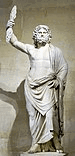 | King of the gods and ruler of Mount Olympus; god of the sky, lightning, thunder, law, order and justice. The youngest child of the Titans Cronus and Rhea. Brother and husband of Hera, although he had many lovers, also brother of Poseidon, Hades, Demeter, and Hestia. His symbols include the thunderbolt, eagle, oak tree, bull, scepter, and scales. |
| Hera | Juno | 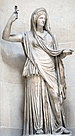 | Queen of the gods and the goddess of marriage, women, childbirth and family. The youngest daughter of Cronus and Rhea. Sister and wife of Zeus. Being the goddess of marriage, she frequently tried to get revenge on Zeus' lovers and their children. Her symbols include the peacock, cuckoo, and cow. |
| Poseidon | Neptune | 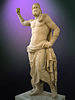 | God of the seas, water, storms, hurricanes, earthquakes and horses. The middle son of Cronus and Rhea. Brother of Zeus and Hades. Married to the Nereid Amphitrite; although, as with many of the male Greek gods, he had many lovers. His symbols include the horse, bull, dolphin, and trident. |
| Demeter | Ceres | 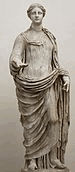 | Goddess of the harvest, fertility, agriculture, nature and the seasons. She presided over grains and the fertility of the earth. The middle daughter of Cronus and Rhea. Also the lover of Zeus and Poseidon, and the mother of Persephone. Her symbols include the poppy, wheat, torch, cornucopia, and pig. |
| Athena | Minerva | 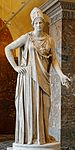 | Goddess of wisdom, handicraft, and warfare.[25] The daughter of Zeus and the Oceanid Metis, she rose from her father's head fully grown and in full battle armor. Her symbols include the owl and the olive tree. |
| Apollo / Apollon | Apollo | 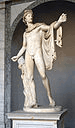 | God of light, the Sun, prophecy, philosophy, archery, truth, inspiration, poetry, music, arts, manly beauty, medicine, healing, and plague. The son of Zeus and Leto, and the twin brother of Artemis. His symbols include the Sun, bow and arrow, lyre, swan, and mouse. |
| Artemis | Diana | 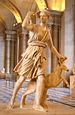 | Goddess of the hunt, the wilderness, virginity, the Moon, archery, childbirth, protection and plague. The daughter of Zeus and Leto, and the twin sister of Apollo. Her symbols include the Moon, horse, deer, hound, she-bear, snake, cypress tree, and bow and arrow. |
| Ares | Mars | 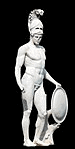 | God of war, violence, bloodshed and manly virtues. The son of Zeus and Hera, all the other gods despised him except Aphrodite. His Latin name, Mars, gave us the word "martial." His symbols include the boar, serpent, dog, vulture, spear, and shield. |
| Aphrodite | Venus | 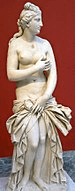 | Goddess of love, pleasure, passion, procreation, fertility, beauty and desire. The daughter of Zeus and the Oceanid Dione, or perhaps born from the sea foam after Uranus' blood dripped into the sea after being castrated by his youngest son, Cronus, who then threw his father's genitals into the sea. Married to Hephaestus, although she had many adulterous affairs, most notably with Ares. Her name gave us the word "aphrodisiac", while her Latin name, Venus, gave us the word "venereal". Her symbols include the dove, bird, apple, bee, swan, myrtle, and rose. |
| Hephaestus | Vulcan | 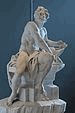 | Master blacksmith and craftsman of the gods; god of the forge, craftsmanship, invention, fire and volcanoes. The son of Hera, either by Zeus or through parthenogenesis. Married to Aphrodite. His Latin name, Vulcan, gave us the word "volcano." His symbols include fire, anvil, axe, donkey, hammer, tongs, and quail. |
| Hermes | Mercury | 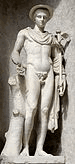 | Messenger of the gods; god of travel, commerce, communication, borders, eloquence, diplomacy, thieves and games. He was also the guide of dead souls. The son of Zeus and the nymph Maia. The second-youngest Olympian, just older than Dionysus. His symbols include the caduceus (staff entwined with two snakes), winged sandals and cap, stork, and tortoise (whose shell he used to invent the lyre). |
| Most lists of the "twelve Olympians" consist of the above eleven plus either Hestia or Dionysus | |||
| Hestia | Vesta | 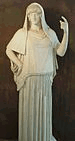 | Goddess of the hearth, fire and of the right ordering of domesticity and the family; she was born into the first Olympian generation and was one of the original twelve Olympians. She is the first child of Cronus and Rhea, the elder sister of Hades, Demeter, Poseidon, Hera, and Zeus. Some lists of the Twelve Olympians omit her in favor of Dionysus, but the speculation that she gave her throne to him in order to keep the peace seems to be modern invention. |
| Dionysus / Bacchus | Bacchus | 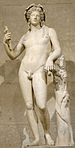 | God of wine, the grape vine, fertility, festivity, ecstasy, madness and resurrection. Patron god of the art of theatre. The son of Zeus and the mortal Theban princess Semele. Married to the Cretan princess Ariadne. The youngest Olympian god, as well as the only one to have a mortal mother. His symbols include the grapevine, ivy, cup, tiger, panther, leopard, dolphin, goat, and pinecone. |
THE BIG THREE

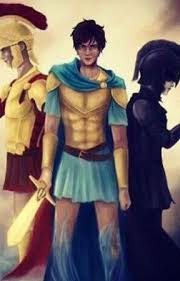
Big Three
English Edit Share
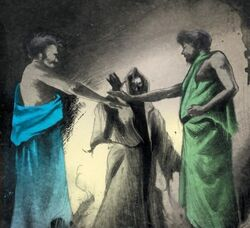 The sons of Kronos making the oath. For the pact of the Big Three, go here.The Big Three is a collective term which refers to the three major Olympian gods: Zeus/Jupiter, Poseidon/Neptune, and Hades/Pluto.
Contents
[show]Description
The Big Three are the three most powerful gods in all of Olympus: Zeus/Jupiter, Poseidon/Neptune and Hades/Pluto, After they had defeated their father Kronos with the help of their sisters, the Elder Cyclopes and the Hekatonkheires, they divided the universe between themselves and then drew lots to see who would get where as their domain: Zeus received the sky and authority over the Olympus, Poseidon received the seas, and Hades received the Underworld. Zeus commands the sky, lightning, and weather, Poseidon can manipulate water, storms, and earthquakes, Hades has dominion over the dead and undead, darkness, earth-related disasters, and metals and jewels.The Earth is split between the three and doesn't belong to any one of them, as all three hold various influences over it and the mortals. Although the Big Three are the most powerful of the gods due to being kings of the three realms, the other gods aren't to be underestimated.
Powers
People believe that Zeus is the strongest among the Big Three (a fact acclaimed in Percy Jackson's Greek Gods), due to possessing the Master Bolt as his weapon and being king of the gods.The powers of the Big Three are directly related: Zeus' control over the weather originates from the Earth's seas, which is Poseidon's domain. Poseidon's control over storms and natural disasters are linked to the weather, which is Zeus' domain. Hades retains his power from people dying while Zeus and Poseidon get their power from people living, fishing, and praying to them.
Demigod Children of the Big Three
A half-blood of the eldest godsShall reach sixteen against all odds
And see the world in endless sleep,
The hero's soul, cursed blade shall reap
A single choice shall end his days.
Olympus to preserve or raze.
All of the Big Three agreed not to have more demigod children since their oath for fear of the Great Prophecy, but Zeus/Jupiter and Poseidon did. Hades/Pluto already had three children before they swore the oath, so technically he never broke it. The worst he did was never sending Nico and Bianca di Angelo to Camp Half-Blood and Hazel Levesque to Camp Jupiter. Poseidon has Percy Jackson and a Cyclops named Tyson, though there was no fear of Tyson fulfilling the first Great Prophecy as it required a demigod. Zeus/Jupiter had two children: Thalia Grace (a Greek demigod) and Jason Grace (a Roman demigod). It is implied in The Last Olympian that the Big Three might have more demigod children as they are now allowed to have children as part of the deal they made with Percy.
| “ | You are children of the three major gods. Who could withstand your combined power? | ” |
| –Persephone to Thalia, Nico, and Percy in, The Sword of Hades | ||
Hazel Levesque
Hazel Levesque is a Roman demigod daughter of Pluto. She died in Alaska in the 1940’s, but was brought back to life in the early twenty-first century by Nico di Angelo. After stopping Gaea from awakening, Hazel was made centurion of the fifth cohort.Nico and Bianca Di Angelo
 BIANCA DI ANGELO
Nico di Angelo, son of Hades Hades already had Nico and Bianca when the Big Three made their agreement. Zeus gave Hades a week to send them to Camp Half-Blood, but Hades never did as he knew that Zeus would destroy them the minute they were out of Hades' territory. It was a week after the deadline and Hades was still trying to convince their mother, Maria di Angelo, to let him take them to the Underworld so he could protect them, but Maria repeatedly said no. The last time Hades saw his lover, she was going upstairs to get her purse when Zeus then struck the building with a lightning bolt, completely destroying it; Hades sensed the attack and had enough time to put a shield around Nico and Bianca, but Maria was killed. It was then that he told one of the Furies; Alecto, to take Nico and Bianca to the Lotus Hotel and Casino, where they would be hidden until he sent for them.When they were found, Bianca joined the Hunters of Artemis while Nico went to Camp Half-Blood. However, Bianca died to save Percy and his friends from a defective version of Talos, leaving Nico as the last child of Hades alive. Nico wandered across the world and the Underworld, orphaned and alone, until he became closer with his father and helped Percy in the Second Titan War.
Thalia and Jason Grace

 File:Thalia1111.png Thalia was the first demigod born after the Oath, but she ended up becoming the tree that guards Camp Half-Blood for almost seven years. She was revived in The Sea of Monsters, when her tree was poisoned by Luke Castellan. Percy Jackson, Annabeth Chase, Clarisse La Rue, Grover Underwood, and Tyson retrieved the Golden Fleece from the Sea of Monsters (the Bermuda Triangle).
However, the fleece worked too well and Thalia was revived from the tree. She later joined Artemis' Hunters, meaning that she wouldn't age and thus couldn't be the half-blood in the Great Prophecy.
Thalia has a Roman younger brother named Jason, but he was abandoned by his mother and taken by Lupa to go train to become a soldier at Camp Jupiter. He helped to stop the awakening of Gaea.
Percy Jackson


 File:60px-PercyCartoon.jpg Percy was the second child of the Big Three to be born after the oath. He is the son of Poseidon and Sally Jackson. He originally didn't know anything about his godly heritage. He is probably the most powerful demigod in Camp Half-Blood, along with Thalia and Nico.
Percy's presence was revealed at the worst possible time, as Zeus' Master Bolt and Hades' Helm of Darkness had been stolen. The appearance of a son of Poseidon made Hades and Zeus suspicious, as gods cannot go into each other's territory, but their children can. Poseidon was the only one of the Big Three that didn't have something stolen from him, placing most of the suspicion on him. Percy found both of the items and returned them, successfully preventing a war.
Percy had more adventures and finally saved Olympus from the Titans, with help of Luke and Annabeth. Since then, Zeus and Hades have stopped hating Percy and now merely dislike him. Although given that Percy is directly responsible for Hades position on the council with full privileges and rights, it would be fair to say that Hades has an improved opinion about Percy.
Trivia
- Chiron mentioned that three is a holy number, as it is the number of the Fates, Big Three, Virgin Goddesses, and the Furies.
- Interestingly, the Big Three each have different eye colors: Zeus has electric blue eyes, Poseidon has sea-green eyes and Hades has black eyes. Their hair, in contrast, is the same as the three of them all have black hair.
- All Greek children of the Big Three have black hair, while neither of the Roman children do.
- During World War II, the Allies which representing the British Commonwealth, the Soviet Union of Socialist Republics, and the United States of America were known as the "Big Three".
- The "Big Three" is used as a collective name for the three major allies of World War I; David Lloyd George, George Clemenceau, and Woodrow Wilson. It is currently unknown whether they are demigods.
Gallery
 Zeus, god of the sky and King of the gods
 Poseidon, god of the sea
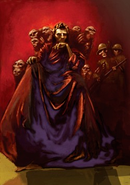 Hades, god of the Underworld
ZEUS GOD ALMIGHTY
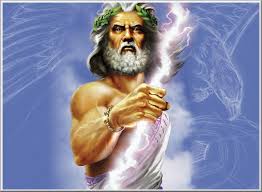
ZEUS
Zeus[a] is the sky and thunder god in ancient Greek religion, who rules as king of the gods of Mount Olympus. His name is cognate with the first element of his Roman equivalent Jupiter. His mythologies and powers are similar, though not identical, to those of Indo-European deities such as Jupiter, Perkūnas, Perun, Indra, Dyaus and Thor.[6][7][8][9]
Zeus is the child of Cronus and Rhea, the youngest of his siblings to be born, though sometimes reckoned the eldest as the others required disgorging from Cronus's stomach. In most traditions, he is married to Hera, by whom he is usually said to have fathered Ares, Hebe, and Hephaestus.[10] At the oracle of Dodona, his consort was said to be Dione, by whom the Iliad states that he fathered Aphrodite.[13] Zeus was also infamous for his erotic escapades. These resulted in many divine and heroic offspring, including Athena, Apollo, Artemis, Hermes, Persephone, Dionysus, Perseus, Heracles, Helen of Troy, Minos, and the Muses.[10]
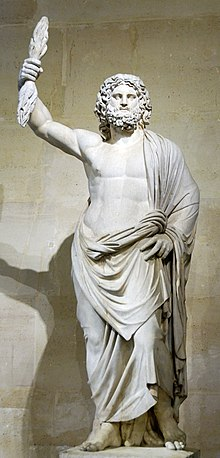
He was respected as an allfather who was chief of the gods[14] and assigned roles to the others:[15] "Even the gods who are not his natural children address him as Father, and all the gods rise in his presence."[16][17] He was equated with many foreign weather gods, permitting Pausanias to observe "That Zeus is king in heaven is a saying common to all men".[18] Zeus' symbols are the thunderbolt, eagle, bull, and oak. In addition to his Indo-European inheritance, the classical "cloud-gatherer" (Greek: Νεφεληγερέτα, Nephelēgereta)[19] also derives certain iconographic traits from the cultures of the ancient Near East, such as the scepter. Zeus is frequently depicted by Greek artists in one of two poses: standing, striding forward with a thunderbolt leveled in his raised right hand, or seated in majesty.
Family
Zeus and Hera
Main article: Hera
Zeus was brother and consort of Hera. By Hera, Zeus sired Ares, Hebe and Hephaestus, though some accounts say that Hera produced these offspring alone. Some also include Eileithyia, Eris, Enyo and Angelos as their daughters. In the section of the Iliad known to scholars as the Deception of Zeus, the two of them are described as having begun their sexual relationship without their parents knowing about it.[37] The conquests of Zeus among nymphs and the mythic mortal progenitors of Hellenic dynasties are famous. Olympian mythography even credits him with unions with Leto, Demeter, Metis, Themis, Eurynome and Mnemosyne.[38][39] Other relationships with immortals included Dione and Maia. Among mortals were Semele, Io, Europa and Leda (for more details, see below) and with the young Ganymede (although he was mortal Zeus granted him eternal youth and immortality).
Many myths render Hera as jealous of his amorous conquests and a consistent enemy of Zeus' mistresses and their children by him. For a time, a nymph named Echo had the job of distracting Hera from his affairs by talking incessantly, and when Hera discovered the deception, she cursed Echo to repeat the words of others.
Transformation of Zeus
Love interest Disguises
Oracles of Zeus
Although most oracle sites were usually dedicated to Apollo, the heroes, or various goddesses like Themis, a few oracular sites were dedicated to Zeus. In addition, some foreign oracles, such as Baʿal's at Heliopolis, were associated with Zeus in Greek or Jupiter in Latin.
The Oracle at Dodona
The cult of Zeus at Dodona in Epirus, where there is evidence of religious activity from the second millennium BC onward, centered on a sacred oak. When the Odyssey was composed (circa 750 BC), divination was done there by barefoot priests called Selloi, who lay on the ground and observed the rustling of the leaves and branches.[115] By the time Herodotus wrote about Dodona, female priestesses called peleiades ("doves") had replaced the male priests.
Zeus' consort at Dodona was not Hera, but the goddess Dione — whose name is a feminine form of "Zeus". Her status as a titaness suggests to some that she may have been a more powerful pre-Hellenic deity, and perhaps the original occupant of the oracle.
The Oracle at Siwa
The oracle of Ammon at the Siwa Oasis in the Western Desert of Egypt did not lie within the bounds of the Greek world before Alexander's day, but it already loomed large in the Greek mind during the archaic era: Herodotus mentions consultations with Zeus Ammon in his account of the Persian War. Zeus Ammon was especially favored at Sparta, where a temple to him existed by the time of the Peloponnesian War.[116]
Roles and epithets
See also: Category:Epithets of Zeus

Roman marble colossal head of Zeus, 2nd century AD (British Museum)[80]
Zeus played a dominant role, presiding over the Greek Olympian pantheon. He fathered many of the heroes and was featured in many of their local cults. Though the Homeric "cloud collector" was the god of the sky and thunder like his Near-Eastern counterparts, he was also the supreme cultural artifact; in some senses, he was the embodiment of Greek religious beliefs and the archetypal Greek deity.
Aside from local epithets that simply designated the deity as doing something random at some particular place, the epithets or titles applied to Zeus emphasized different aspects of his wide-ranging authority:

A bust of Zeus.
Additional names and epithets for Zeus are also:
Zeus[a] is the sky and thunder god in ancient Greek religion, who rules as king of the gods of Mount Olympus. His name is cognate with the first element of his Roman equivalent Jupiter. His mythologies and powers are similar, though not identical, to those of Indo-European deities such as Jupiter, Perkūnas, Perun, Indra, Dyaus and Thor.[6][7][8][9]
Zeus is the child of Cronus and Rhea, the youngest of his siblings to be born, though sometimes reckoned the eldest as the others required disgorging from Cronus's stomach. In most traditions, he is married to Hera, by whom he is usually said to have fathered Ares, Hebe, and Hephaestus.[10] At the oracle of Dodona, his consort was said to be Dione, by whom the Iliad states that he fathered Aphrodite.[13] Zeus was also infamous for his erotic escapades. These resulted in many divine and heroic offspring, including Athena, Apollo, Artemis, Hermes, Persephone, Dionysus, Perseus, Heracles, Helen of Troy, Minos, and the Muses.[10]
He was respected as an allfather who was chief of the gods[14] and assigned roles to the others:[15] "Even the gods who are not his natural children address him as Father, and all the gods rise in his presence."[16][17] He was equated with many foreign weather gods, permitting Pausanias to observe "That Zeus is king in heaven is a saying common to all men".[18] Zeus' symbols are the thunderbolt, eagle, bull, and oak. In addition to his Indo-European inheritance, the classical "cloud-gatherer" (Greek: Νεφεληγερέτα, Nephelēgereta)[19] also derives certain iconographic traits from the cultures of the ancient Near East, such as the scepter. Zeus is frequently depicted by Greek artists in one of two poses: standing, striding forward with a thunderbolt leveled in his raised right hand, or seated in majesty.
| King of the Gods God of the sky, lightning, thunder, law, order, justice | |
 ] ] | |
| Mount Olympus | |
| Thunderbolt, eagle, bull, oak | |
| Thursday | |
Family
Zeus and Hera
Main article: Hera
Zeus was brother and consort of Hera. By Hera, Zeus sired Ares, Hebe and Hephaestus, though some accounts say that Hera produced these offspring alone. Some also include Eileithyia, Eris, Enyo and Angelos as their daughters. In the section of the Iliad known to scholars as the Deception of Zeus, the two of them are described as having begun their sexual relationship without their parents knowing about it.[37] The conquests of Zeus among nymphs and the mythic mortal progenitors of Hellenic dynasties are famous. Olympian mythography even credits him with unions with Leto, Demeter, Metis, Themis, Eurynome and Mnemosyne.[38][39] Other relationships with immortals included Dione and Maia. Among mortals were Semele, Io, Europa and Leda (for more details, see below) and with the young Ganymede (although he was mortal Zeus granted him eternal youth and immortality).
Many myths render Hera as jealous of his amorous conquests and a consistent enemy of Zeus' mistresses and their children by him. For a time, a nymph named Echo had the job of distracting Hera from his affairs by talking incessantly, and when Hera discovered the deception, she cursed Echo to repeat the words of others.
Transformation of Zeus
Love interest Disguises
| Aegina | an eagle or a flame of fire |
| Alcmene | Amphitryon |
| Antiope | a satyr |
| Asopis | a flame of fire |
| Callisto | Artemis |
| Cassiopeia | Phoenix |
| Danae | shower of gold |
| Europa | a bull |
| Eurymedusa | ant |
| Ganymede | an eagle |
| Imandra | a shower |
| Lamia | a lapwing |
| Leda | a swan and a star |
| Manthea | a bear |
| Mnemosyne | a shepherd |
| Nemesis | a goose |
| Persephone | a serpent |
| Semele | a fire |
| Thalia | a vulture |
Although most oracle sites were usually dedicated to Apollo, the heroes, or various goddesses like Themis, a few oracular sites were dedicated to Zeus. In addition, some foreign oracles, such as Baʿal's at Heliopolis, were associated with Zeus in Greek or Jupiter in Latin.
The Oracle at Dodona
The cult of Zeus at Dodona in Epirus, where there is evidence of religious activity from the second millennium BC onward, centered on a sacred oak. When the Odyssey was composed (circa 750 BC), divination was done there by barefoot priests called Selloi, who lay on the ground and observed the rustling of the leaves and branches.[115] By the time Herodotus wrote about Dodona, female priestesses called peleiades ("doves") had replaced the male priests.
Zeus' consort at Dodona was not Hera, but the goddess Dione — whose name is a feminine form of "Zeus". Her status as a titaness suggests to some that she may have been a more powerful pre-Hellenic deity, and perhaps the original occupant of the oracle.
The Oracle at Siwa
The oracle of Ammon at the Siwa Oasis in the Western Desert of Egypt did not lie within the bounds of the Greek world before Alexander's day, but it already loomed large in the Greek mind during the archaic era: Herodotus mentions consultations with Zeus Ammon in his account of the Persian War. Zeus Ammon was especially favored at Sparta, where a temple to him existed by the time of the Peloponnesian War.[116]
Roles and epithets
See also: Category:Epithets of Zeus
Roman marble colossal head of Zeus, 2nd century AD (British Museum)[80]
Zeus played a dominant role, presiding over the Greek Olympian pantheon. He fathered many of the heroes and was featured in many of their local cults. Though the Homeric "cloud collector" was the god of the sky and thunder like his Near-Eastern counterparts, he was also the supreme cultural artifact; in some senses, he was the embodiment of Greek religious beliefs and the archetypal Greek deity.
Aside from local epithets that simply designated the deity as doing something random at some particular place, the epithets or titles applied to Zeus emphasized different aspects of his wide-ranging authority:
- Zeus Aegiduchos or Aegiochos: Usually taken as Zeus as the bearer of the Aegis, the divine shield with the head of Medusa across it,[81][82][83] although others derive it from "goat" (αἴξ) and okhē (οχή) in reference to Zeus' nurse, the divine goat Amalthea.[84][85]
- Zeus Agoraeus: Zeus as patron of the marketplace (agora) and punisher of dishonest traders.
- Zeus Areius: either "warlike" or "the atoning one".
- Zeus Horkios: Zeus as keeper of oaths. Exposed liars were made to dedicate a votive statue to Zeus, often at the sanctuary at Olympia
- Zeus Olympios: Zeus as king of the gods and patron of the Panhellenic Games at Olympia
- Zeus Panhellenios ("Zeus of All the Greeks"): worshipped at Aeacus's temple on Aegina
- Zeus Xenios, Philoxenon, or Hospites: Zeus as the patron of hospitality (xenia) and guests, avenger of wrongs done to strangers
A bust of Zeus.
Additional names and epithets for Zeus are also:
- Abrettenus (Ἀβρεττηνός) or Abretanus: surname of Zeus in Mysia[86]
- Achad: one of his names in Syria.
- Acraeus: his name at Smyrna.
- Acrettenus: his name in Mysia.
- Adad: one of his names in Syria.
- Adultus: from his being invoked by adults, on their marriage.
- Apemius: Zeus as the averter of ills
- Apomyius Zeus as one who dispels flies
- Astrapios ("Lightninger"): Zeus as a weather god
- Bottiaeus: Worshipped at Antioch[87]
- Brontios ("Thunderer"): Zeus as a weather god
- Diktaios: Zeus as lord of the Dikte mountain range, worshipped from Mycenaean times on Crete[88]
- Ithomatas: Worshipped at Mount Ithome in Messenia
- Zeus Adados: A Hellenization of the Canaanite Hadad and Assyrian Adad, particularly his solar cult at Heliopolis[89]
- Zeus Bouleus: Worshipped at Dodona, the earliest oracle, along with Zeus Naos
- Zeus Georgos (Ζεὺς Γεωργός, "Zeus the Farmer"): Zeus as god of crops and the harvest, worshipped in Athens
- Zeus Helioupolites ("Heliopolite" or "Heliopolitan Zeus"): A Hellenization of the Canaanite Baʿal (probably Hadad) worshipped as a sun god at Heliopolis (modern Baalbek)[89]
- Zeus Kasios ("Zeus of Mount Kasios" the modern Jebel Aqra): Worshipped at a site on the Syrian–Turkish border, a Hellenization of the Canaanite mountain and weather god Baal Zephon
- Zeus Labrandos ("Zeus of Labraunda"): Worshiped at Caria, depicted with a double-edged axe (labrys), a Hellenization of the Hurrian weather god Teshub
- Zeus Meilichios ("Zeus the Easily-Entreated"): Worshipped at Athens, a form of the archaic chthonic daimon Meilichios
- Zeus Naos: Worshipped at Dodona, the earliest oracle, along with Zeus Bouleus
- Zeus Tallaios ("Solar Zeus"): Worshipped on Crete
- Hetareios (Ἑταιρεῖος, "of fellowship"). According to the Suda, Zeus was called this among the Cretans.[90]
- Eleutherios (Ἐλευθέριος, "of freedom"). At Athens after the Battle of Plataea, Athenians built the Stoa of Zeus Eleutherios.[91] Some writers said that was called "of freedom" because free men built the portico near his shrine, while others because Athenians escaped subjection to the power of Persia and they were free.[92]
- Bottiaios (Βοττιαίος, "of the Bottiaei"). Libanius wrote that Alexander the Great founded the temple of Zeus Bottiaios, in the place where later the city of Antioch was built.[93][94]
- Ourios (Οὐριος, "of favourable wind"). Ancient writers wrote about a sanctuary at the opening of the Black Sea dedicated to the Zeus Ourios (ἱερὸν τοῦ Διὸς τοῦ Οὐρίου).[95] In addition, on the island of Delos a dedication to Zeus Ourios was found. The dedication was made by a citizen of Ascalon, named Damon son of Demetrius, who escaped from pirates.[96]
POSEIDON THE SEA GOD

POSEIDON

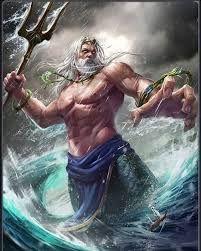
Poseidon (/pəˈsaɪdən, pɒ-, poʊ-/;[1] Greek: Ποσειδῶν, pronounced [poseːdɔ́ːn]) was one of the Twelve Olympians in ancient Greek religion and myth, god of the sea, storms, earthquakes and horses.[2] In pre-Olympian Bronze Age Greece, he was venerated as a chief deity at Pylos and Thebes.[2] His Roman equivalent is Neptune.
Poseidon was protector of seafarers, and of many Hellenic cities and colonies. In Homer's Iliad, Poseidon supports the Greeks against the Trojans during the Trojan War and in the Odyssey, during the sea-voyage from Troy back home to Ithaca, the Greek hero Odysseus provokes Poseidon's fury by blinding his son, the Cyclops Polyphemus, resulting in Poseidon punishing him with storms, the complete loss of his ship and companions, and a ten-year delay. Poseidon is also the subject of a Homeric hymn. In Plato's Timaeus and Critias, the island of Atlantis was Poseidon's domain
PoseidonAbodeSymbolPersonal informationParentsSiblingsConsortChildrenRoman equivalent
Poseidon was the second son of the Titans Cronus and Rhea. In most accounts he is swallowed by Cronus at birth and is later saved, along with his other brothers and sisters, by Zeus.
However, in some versions of the story, he, like his brother Zeus, did not share the fate of his other brother and sisters who were eaten by Cronus. He was saved by his mother Rhea, who concealed him among a flock of lambs and pretended to have given birth to a colt, which she gave to Cronus to devour.[44]
According to John Tzetzes[45] the kourotrophos, or nurse of Poseidon was Arne, who denied knowing where he was, when Cronus came searching; according to Diodorus Siculus[46] Poseidon was raised by the Telchines on Rhodes, just as Zeus was raised by the Korybantes on Crete.
According to a single reference in the Iliad, when the world was divided by lot in three, Zeus received the sky, Hades the underworld and Poseidon the sea.[47]
In Homer's Odyssey (Book V, ln. 398), Poseidon has a home in Aegae.
Foundation of Athens
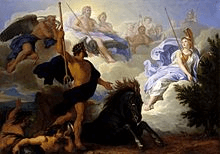
The Dispute of Minerva and Neptune by René-Antoine Houasse (circa 1689 or 1706)
Athena became the patron goddess of the city of Athens after a competition with Poseidon. Yet Poseidon remained a numinous presence on the Acropolis in the form of his surrogate, Erechtheus.[2] At the dissolution festival at the end of the year in the Athenian calendar, the Skira, the priests of Athena and the priest of Poseidon would process under canopies to Eleusis.[48] They agreed that each would give the Athenians one gift and the Athenians would choose whichever gift they preferred. Poseidon struck the ground with his trident and a spring sprang up; the water was salty and not very useful,[49] whereas Athena offered them an olive tree.
The Athenians or their king, Cecrops, accepted the olive tree and along with it Athena as their patron, for the olive tree brought wood, oil and food. After the fight, infuriated at his loss, Poseidon sent a monstrous flood to the Attic Plain, to punish the Athenians for not choosing him. The depression made by Poseidon's trident and filled with salt water was surrounded by the northern hall of the Erechtheum, remaining open to the air. "In cult, Poseidon was identified with Erechtheus," Walter Burkert noted; "the myth turns this into a temporal-causal sequence: in his anger at losing, Poseidon led his son Eumolpus against Athens and killed Erectheus."[50]
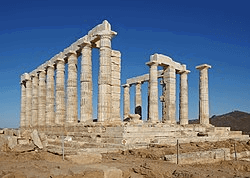
Temple of Poseidon at Cape Sounion, ca 440 BC
The contest of Athena and Poseidon was the subject of the reliefs on the western pediment of the Parthenon, the first sight that greeted the arriving visitor.
This myth is construed by Robert Graves and others as reflecting a clash between the inhabitants during Mycenaean times and newer immigrants. Athens at its height was a significant sea power, at one point defeating the Persian fleet at Salamis Island in a sea battle.
THATS ALL FOR TODAY THANKS GUYS FOR READING.HOPE U GUYS STAY GOOD.
99999999999(((ARK RAIHAN)0000000000000
Poseidon (/pəˈsaɪdən, pɒ-, poʊ-/;[1] Greek: Ποσειδῶν, pronounced [poseːdɔ́ːn]) was one of the Twelve Olympians in ancient Greek religion and myth, god of the sea, storms, earthquakes and horses.[2] In pre-Olympian Bronze Age Greece, he was venerated as a chief deity at Pylos and Thebes.[2] His Roman equivalent is Neptune.
Poseidon was protector of seafarers, and of many Hellenic cities and colonies. In Homer's Iliad, Poseidon supports the Greeks against the Trojans during the Trojan War and in the Odyssey, during the sea-voyage from Troy back home to Ithaca, the Greek hero Odysseus provokes Poseidon's fury by blinding his son, the Cyclops Polyphemus, resulting in Poseidon punishing him with storms, the complete loss of his ship and companions, and a ten-year delay. Poseidon is also the subject of a Homeric hymn. In Plato's Timaeus and Critias, the island of Atlantis was Poseidon's domain
PoseidonAbodeSymbolPersonal informationParentsSiblingsConsortChildrenRoman equivalent
| God of the sea, storms, earthquakes, horses | |
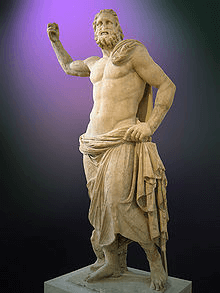 Poseidon from Milos, 2nd century BC (National Archaeological Museum of Athens) Poseidon from Milos, 2nd century BC (National Archaeological Museum of Athens) | |
| Mount Olympus, or the Sea | |
| Trident, fish, dolphin, horse, bull | |
| Cronus and Rhea | |
| Hades, Demeter, Hestia, Hera, Zeus, Chiron | |
| Amphitrite, Aphrodite, Demeter, various others | |
| Theseus Triton Polyphemus Orion Belus Agenor Neleus Atlas (the first king of Atlantis) Pegasus Chrysaor | |
| Neptune | |
However, in some versions of the story, he, like his brother Zeus, did not share the fate of his other brother and sisters who were eaten by Cronus. He was saved by his mother Rhea, who concealed him among a flock of lambs and pretended to have given birth to a colt, which she gave to Cronus to devour.[44]
According to John Tzetzes[45] the kourotrophos, or nurse of Poseidon was Arne, who denied knowing where he was, when Cronus came searching; according to Diodorus Siculus[46] Poseidon was raised by the Telchines on Rhodes, just as Zeus was raised by the Korybantes on Crete.
According to a single reference in the Iliad, when the world was divided by lot in three, Zeus received the sky, Hades the underworld and Poseidon the sea.[47]
In Homer's Odyssey (Book V, ln. 398), Poseidon has a home in Aegae.
Foundation of Athens
The Dispute of Minerva and Neptune by René-Antoine Houasse (circa 1689 or 1706)
Athena became the patron goddess of the city of Athens after a competition with Poseidon. Yet Poseidon remained a numinous presence on the Acropolis in the form of his surrogate, Erechtheus.[2] At the dissolution festival at the end of the year in the Athenian calendar, the Skira, the priests of Athena and the priest of Poseidon would process under canopies to Eleusis.[48] They agreed that each would give the Athenians one gift and the Athenians would choose whichever gift they preferred. Poseidon struck the ground with his trident and a spring sprang up; the water was salty and not very useful,[49] whereas Athena offered them an olive tree.
The Athenians or their king, Cecrops, accepted the olive tree and along with it Athena as their patron, for the olive tree brought wood, oil and food. After the fight, infuriated at his loss, Poseidon sent a monstrous flood to the Attic Plain, to punish the Athenians for not choosing him. The depression made by Poseidon's trident and filled with salt water was surrounded by the northern hall of the Erechtheum, remaining open to the air. "In cult, Poseidon was identified with Erechtheus," Walter Burkert noted; "the myth turns this into a temporal-causal sequence: in his anger at losing, Poseidon led his son Eumolpus against Athens and killed Erectheus."[50]
Temple of Poseidon at Cape Sounion, ca 440 BC
The contest of Athena and Poseidon was the subject of the reliefs on the western pediment of the Parthenon, the first sight that greeted the arriving visitor.
This myth is construed by Robert Graves and others as reflecting a clash between the inhabitants during Mycenaean times and newer immigrants. Athens at its height was a significant sea power, at one point defeating the Persian fleet at Salamis Island in a sea battle.
THATS ALL FOR TODAY THANKS GUYS FOR READING.HOPE U GUYS STAY GOOD.
99999999999(((ARK RAIHAN)0000000000000
HADES
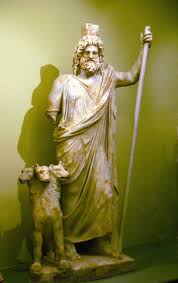
HADES
Hades (/ˈheɪdiːz/; Greek: ᾍδης Hádēs; Ἅιδης Háidēs), in the ancient Greek religion and myth, is the god of the dead and the king of the underworld, with which his name became synonymous.[1] Hades was the eldest son of Cronus and Rhea, although the last son regurgitated by his father.[2] He and his brothers, Zeus and Poseidon, defeated their father's generation of gods, the Titans, and claimed rulership over the cosmos. Hades received the underworld, Zeus the sky, and Poseidon the sea, with the solid earth, long the province of Gaia, available to all three concurrently. Hades was often portrayed with his three-headed guard dog Cerberus.
The Etruscan god Aita and the Roman gods Dis Pater and Orcus were eventually taken as equivalent to Hades and merged into Pluto, a Latinization of Plouton (Greek: Πλούτων, Ploútōn),[3] itself a euphemistic title often given to Hades.
In Greek mythology, Hades, the god of the underworld, was the first-born son of the Titans Cronus and Rhea. He had three older sisters, Hestia, Demeter, and Hera, as well as a younger brother, Poseidon, all of whom had been swallowed whole by their father as soon as they were born. Zeus was the youngest child and through the machinations of their mother, Rhea, he was the only one that had escaped this fate. Upon reaching adulthood, Zeus managed to force his father to disgorge his siblings. After their release, the six younger gods, along with allies they managed to gather, challenged the elder gods for power in the Titanomachy, a divine war. The war lasted for ten years and ended with the victory of the younger gods. Following their victory, according to a single famous passage in the Iliad (Book XV, ln.187–93), Hades and his two brothers, Poseidon and Zeus, drew lots[20] for realms to rule. Zeus received the sky, Poseidon received the seas, and Hades received the underworld,[21] the unseen realm to which the souls of the dead go upon leaving the world as well as any and all things beneath the earth. Some myths suggest that Hades was dissatisfied with his turnout, but had no choice and moved to his new realm.[22]
Hades obtained his wife and queen, Persephone, through abduction at the behest of Zeus. This myth is the most important one Hades takes part in;[23] it also connected the Eleusinian Mysteries with the Olympian pantheon, particularly as represented in the Homeric Hymn to Demeter, which is the oldest story of the abduction, most likely dating back to the beginning of the 6th century BC.[10] Helios told the grieving Demeter that Hades was not unworthy as a consort for Persephone:
 In older Greek myths, the realm of Hades is the misty and gloomy[78] abode of the dead (also called Erebus[78]) where all mortals go when they die. Very few mortals could leave Hades once they entered. The exceptions, Heracles and Theseus, are heroic.[79] Even Odysseus in his Nekyia (Odyssey, xi) calls up the spirits of the departed, rather than descend to them. Later Greek philosophy introduced the idea that all mortals are judged after death and are either rewarded or cursed.[citation needed]There were several sections of the realm of Hades, including Elysium, the Asphodel Meadows, and Tartarus. The mythographer Apollodorus, describes Tartarus as "a gloomy place in Hades as far distant from earth as earth is distant from the sky."[80] Greek mythographers were not perfectly consistent about the geography of the afterlife. A contrasting myth of the afterlife concerns the Garden of the Hesperides, often identified with the Isles of the Blessed, where the blessed heroes may dwell.
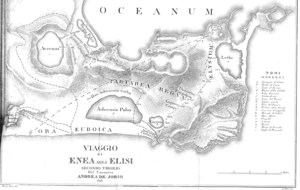 Aeneas's journey to Hades through the entrance at Cumae mapped by Andrea de Jorio, 1825
In Roman mythology, the entrance to the Underworld located at Avernus, a crater near Cumae, was the route Aeneas used to descend to the realm of the dead.[81] By synecdoche, "Avernus" could be substituted for the underworld as a whole. The di inferi were a collective of underworld divinities.
For Hellenes, the deceased entered the underworld by crossing the Styx, ferried across by Charon kair'-on), who charged an obolus, a small coin for passage placed in the mouth of the deceased by pious relatives. Paupers and the friendless gathered for a hundred years on the near shore according to Book VI of Vergil's Aeneid. Greeks offered propitiatory libations to prevent the deceased from returning to the upper world to "haunt" those who had not given them a proper burial. The far side of the river was guarded by Cerberus, the three-headed dog defeated by Heracles (Roman Hercules). Passing beyond Cerberus, the shades of the departed entered the land of the dead to be judged.
The five rivers of the realm of Hades, and their symbolic meanings, are Acheron (the river of sorrow, or woe), Cocytus (lamentation), Phlegethon (fire), Lethe (oblivion), and Styx (hate), the river upon which even the gods swore and in which Achilles was dipped to render him invincible. The Styx forms the boundary between the upper and lower worlds. See also Eridanos.
The first region of Hades comprises the Fields of Asphodel, described in Odyssey xi, where the shades of heroes wander despondently among lesser spirits, who twitter around them like bats. Only libations of blood offered to them in the world of the living can reawaken in them for a time the sensations of humanity.
Beyond lay Erebus, which could be taken for a euphonym of Hades, whose own name was dread. There were two pools, that of Lethe, where the common souls flocked to erase all memory, and the pool of Mnemosyne ("memory"), where the initiates of the Mysteries drank instead. In the forecourt of the palace of Hades and Persephone sit the three judges of the Underworld: Minos, Rhadamanthus, and Aeacus. There at the trivium sacred to Hecate, where three roads meet, souls are judged, returned to the Fields of Asphodel if they are neither virtuous nor evil, sent by the road to Tartarus if they are impious or evil, or sent to Elysium (Islands of the Blessed) with the "blameless" heroes.
In the Sibylline oracles, a curious hodgepodge of Greco-Roman and Judaeo-Christian elements, Hades again appears as the abode of the dead, and by way of folk etymology, it even derives Hades from the name Adam (the first man), saying it is because he was the first to enter there.[82] Owing to its appearance in the New Testament of the Bible, Hades also has a distinct meaning in Christianity.
Hades (/ˈheɪdiːz/; Greek: ᾍδης Hádēs; Ἅιδης Háidēs), in the ancient Greek religion and myth, is the god of the dead and the king of the underworld, with which his name became synonymous.[1] Hades was the eldest son of Cronus and Rhea, although the last son regurgitated by his father.[2] He and his brothers, Zeus and Poseidon, defeated their father's generation of gods, the Titans, and claimed rulership over the cosmos. Hades received the underworld, Zeus the sky, and Poseidon the sea, with the solid earth, long the province of Gaia, available to all three concurrently. Hades was often portrayed with his three-headed guard dog Cerberus.
The Etruscan god Aita and the Roman gods Dis Pater and Orcus were eventually taken as equivalent to Hades and merged into Pluto, a Latinization of Plouton (Greek: Πλούτων, Ploútōn),[3] itself a euphemistic title often given to Hades.
In Greek mythology, Hades, the god of the underworld, was the first-born son of the Titans Cronus and Rhea. He had three older sisters, Hestia, Demeter, and Hera, as well as a younger brother, Poseidon, all of whom had been swallowed whole by their father as soon as they were born. Zeus was the youngest child and through the machinations of their mother, Rhea, he was the only one that had escaped this fate. Upon reaching adulthood, Zeus managed to force his father to disgorge his siblings. After their release, the six younger gods, along with allies they managed to gather, challenged the elder gods for power in the Titanomachy, a divine war. The war lasted for ten years and ended with the victory of the younger gods. Following their victory, according to a single famous passage in the Iliad (Book XV, ln.187–93), Hades and his two brothers, Poseidon and Zeus, drew lots[20] for realms to rule. Zeus received the sky, Poseidon received the seas, and Hades received the underworld,[21] the unseen realm to which the souls of the dead go upon leaving the world as well as any and all things beneath the earth. Some myths suggest that Hades was dissatisfied with his turnout, but had no choice and moved to his new realm.[22]
Hades obtained his wife and queen, Persephone, through abduction at the behest of Zeus. This myth is the most important one Hades takes part in;[23] it also connected the Eleusinian Mysteries with the Olympian pantheon, particularly as represented in the Homeric Hymn to Demeter, which is the oldest story of the abduction, most likely dating back to the beginning of the 6th century BC.[10] Helios told the grieving Demeter that Hades was not unworthy as a consort for Persephone:
In older Greek myths, the realm of Hades is the misty and gloomy[78] abode of the dead (also called Erebus[78]) where all mortals go when they die. Very few mortals could leave Hades once they entered. The exceptions, Heracles and Theseus, are heroic.[79] Even Odysseus in his Nekyia (Odyssey, xi) calls up the spirits of the departed, rather than descend to them. Later Greek philosophy introduced the idea that all mortals are judged after death and are either rewarded or cursed.[citation needed]There were several sections of the realm of Hades, including Elysium, the Asphodel Meadows, and Tartarus. The mythographer Apollodorus, describes Tartarus as "a gloomy place in Hades as far distant from earth as earth is distant from the sky."[80] Greek mythographers were not perfectly consistent about the geography of the afterlife. A contrasting myth of the afterlife concerns the Garden of the Hesperides, often identified with the Isles of the Blessed, where the blessed heroes may dwell.Aeneas's journey to Hades through the entrance at Cumae mapped by Andrea de Jorio, 1825In Roman mythology, the entrance to the Underworld located at Avernus, a crater near Cumae, was the route Aeneas used to descend to the realm of the dead.[81] By synecdoche, "Avernus" could be substituted for the underworld as a whole. The di inferi were a collective of underworld divinities.
For Hellenes, the deceased entered the underworld by crossing the Styx, ferried across by Charon kair'-on), who charged an obolus, a small coin for passage placed in the mouth of the deceased by pious relatives. Paupers and the friendless gathered for a hundred years on the near shore according to Book VI of Vergil's Aeneid. Greeks offered propitiatory libations to prevent the deceased from returning to the upper world to "haunt" those who had not given them a proper burial. The far side of the river was guarded by Cerberus, the three-headed dog defeated by Heracles (Roman Hercules). Passing beyond Cerberus, the shades of the departed entered the land of the dead to be judged.
The five rivers of the realm of Hades, and their symbolic meanings, are Acheron (the river of sorrow, or woe), Cocytus (lamentation), Phlegethon (fire), Lethe (oblivion), and Styx (hate), the river upon which even the gods swore and in which Achilles was dipped to render him invincible. The Styx forms the boundary between the upper and lower worlds. See also Eridanos.
The first region of Hades comprises the Fields of Asphodel, described in Odyssey xi, where the shades of heroes wander despondently among lesser spirits, who twitter around them like bats. Only libations of blood offered to them in the world of the living can reawaken in them for a time the sensations of humanity.
Beyond lay Erebus, which could be taken for a euphonym of Hades, whose own name was dread. There were two pools, that of Lethe, where the common souls flocked to erase all memory, and the pool of Mnemosyne ("memory"), where the initiates of the Mysteries drank instead. In the forecourt of the palace of Hades and Persephone sit the three judges of the Underworld: Minos, Rhadamanthus, and Aeacus. There at the trivium sacred to Hecate, where three roads meet, souls are judged, returned to the Fields of Asphodel if they are neither virtuous nor evil, sent by the road to Tartarus if they are impious or evil, or sent to Elysium (Islands of the Blessed) with the "blameless" heroes.
In the Sibylline oracles, a curious hodgepodge of Greco-Roman and Judaeo-Christian elements, Hades again appears as the abode of the dead, and by way of folk etymology, it even derives Hades from the name Adam (the first man), saying it is because he was the first to enter there.[82] Owing to its appearance in the New Testament of the Bible, Hades also has a distinct meaning in Christianity.
HERA THE QUEEN OF OLYMPUS
- Hera
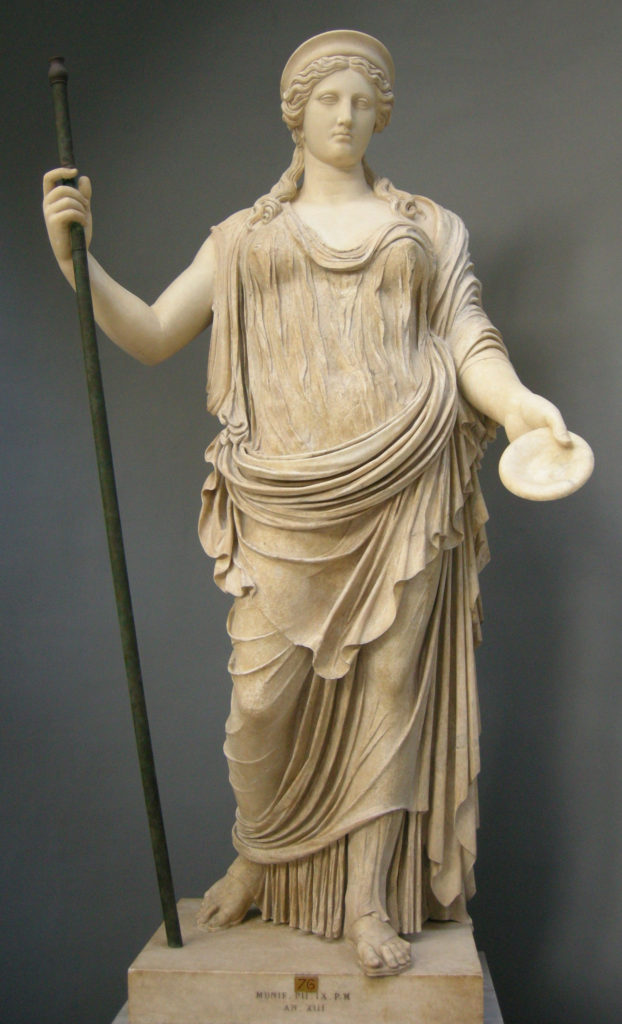 Hera, Greek Goddess of MarriageHERA FACTS
| Name(s): | Hera |
| Rules over: | Marriage, Women, Birth, the Heavens |
| Title: | Queen of Heaven |
| Gender: | Female |
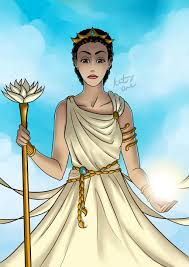
| Symbols: | Diadem, Scepter, Pomegranate |
| Sacred animals: | Peacock, Cow |
| Items: | Lily (flower) |
| Parents: | Cronus and Rhea |
| Consort: | Zeus |
| Children: | Ares, Enyo, Hebe, Eileithyia, Hephaestus, Angelos, Eris |
| ROMAN NAME = JUNE |
Greek Goddess of Marriage and Queen of Olympus
Hera is the Queen of the Gods and is the wife and sister of Zeus in the Olympian pantheon. She is known for being the Goddess of Marriage & Birth. Despite being the Goddess of Marriage, she was known to be jealous and vengeful towards the many lovers and offspring of her husband Zeus.She was also known to turn her anger towards mortals who crossed her as well – for example, Paris, who chose Aphrodite over Hera as the most beautiful goddess at the marriage of the sea-nymph Thetis to a mortal called Peleus.
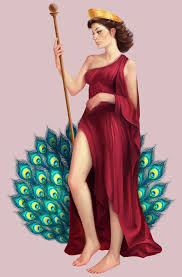
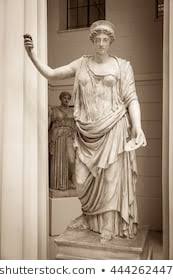
In images and statues, Hera is portrayed as being majestic and solemn, crowned with the polos – a high cylindrical crown worn by many of the Great Goddesses.
Even before her marriage with Zeus, she ruled over the heavens and the Earth. This is one reason why she is referred to as ‘The Queen of Heaven’ – ruling over Mount Olympus where all the gods and goddesses live.
Even the great Zeus feared his wife Hera. Her never-ending hatred of Heracles, the illegitimate son of Zeus and the mortal Alcmene stemmed from his continuous adultery and, amongst other things, Hera raised a storm at sea in order to drive Heracles out of his course to kill him.
Zeus became so angry that he hung her in the clouds by a golden chain, and attached heavy anvils to her feet. Her son Hephaestus tried to release his mother from her humiliating position, for which Zeus threw him out of heaven, and his leg was broken by the fall.
Facts about Hera
- Hera was Queen of the Olympian gods.
- She was the wife and sister of Zeus.
- Hera was a jealous wife, and she fought with Zeus frequently over his extramarital affairs and illegitimate children. For this reason, Hera was known for punishing offending husbands.
- She was the protector of women, presiding over marriages and births.
- While Hera was worshipped in all parts of Greece, temples were erected in her honor at Argos and Salmos.
- The peacock was sacred to her.
- Hera had few, if any, redeeming qualities. She never forgot an injury.
- The Titans Ocean and Tethys brought her up.
- Hera is often described as “cow-faced,” although she was also called the chief among the immortals in beauty.
- Though she may have been physically attractive, her vindictive personality makes her less so.
- The Trojan War would have ended in peace, but Hera had a vested interest in its outcome and influenced Zeus to either switch sides or remain neutral.
- Hera had no concept of justice when angry or jealous; she could not forgive the women with whom Zeus had sexual relations—even if they were innocent of wrongdoing.
- Ilithyia, a daughter of Hera’s, assisted women in childbirth.
- In the story of the Quest of the Golden Fleece, Hera was a gracious protector of the heroes.
- Paris awarded Aphrodite the Golden Apple over Athena and Hera.
- Hera punished one of Zeus’s love interests, Io, by putting her in the charge of Argus. Argus had a hundred eyes and kept vigilant watch over her so that Zeus could not come to her aid.
- Hera turned Callisto into a bear because Zeus fell in love with her.
- Hera arranged the death of Semele, another of Zeus’s mortal conquests, although she did not directly cause it.
- Hera never forgave Hercules for being Zeus’s son, but when Hercules died and was taken to heaven, he and Hera reconciled. While in heaven, Hercules married Hera’s daughter Hebe.
- In some stories, it was at Hera’s orders that Dionysus was torn to pieces. He was brought back to life, and it is this resurrection that was celebrated in theatres
Hera may have been the first deity to whom the Greeks dedicated an enclosed roofed temple sanctuary, at Samos about 800 BCE. It was replaced later by the Heraion of Samos, one of the largest of all Greek temples (altars were in front of the temples under the open sky). There were many temples built on this site so evidence is somewhat confusing and archaeological dates are uncertain.
The temple created by the Rhoecus sculptors and architects was destroyed between 570–560 BCE. This was replaced by the Polycratean temple of 540–530 BCE. In one of these temples we see a forest of 155 columns. There is also no evidence of tiles on this temple suggesting either the temple was never finished or that the temple was open to the sky.
Earlier sanctuaries, whose dedication to Hera is less certain, were of the Mycenaean type called "house sanctuaries".[12] Samos excavations have revealed votive offerings, many of them late 8th and 7th centuries BCE, which show that Hera at Samos was not merely a local Greek goddess of the Aegean: the museum there contains figures of gods and suppliants and other votive offerings from Armenia, Babylon, Iran, Assyria, Egypt, testimony to the reputation which this sanctuary of Hera enjoyed and to the large influx of pilgrims. Compared to this mighty goddess, who also possessed the earliest temple at Olympia and two of the great fifth and sixth century temples of Paestum, the termagant of Homer and the myths is an "almost... comic figure", according to Burkert.[13]
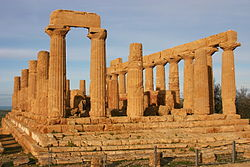
The Temple of Hera at Agrigento, Magna Graecia.
Though greatest and earliest free-standing temple to Hera was the Heraion of Samos, in the Greek mainland Hera was especially worshipped as "Argive Hera" (Hera Argeia) at her sanctuary that stood between the former Mycenaean city-states of Argos and Mycenae,[14][15] where the festivals in her honor called Heraia were celebrated. "The three cities I love best," the ox-eyed Queen of Heaven declares in the Iliad, book iv, "are Argos, Sparta and Mycenae of the broad streets." There were also temples to Hera in Olympia, Corinth, Tiryns, Perachora and the sacred island of Delos. In Magna Graecia, two Doric temples to Hera were constructed at Paestum, about 550 BCE and about 450 BCE. One of them, long called the Temple of Poseidon was identified in the 1950s as a second temple there of Hera.[16]
In Euboea, the festival of the Great Daedala, sacred to Hera, was celebrated on a sixty-year cycle.
Hera's importance in the early archaic period is attested by the large building projects undertaken in her honor. The temples of Hera in the two main centers of her cult, the Heraion of Samos and the Heraion of Argos in the Argolis, were the very earliest monumental Greek temples constructed, in the 8th century BCE.[17]
Importance
According to Walter Burkert, both Hera and Demeter have many characteristic attributes of Pre-Greek Great Goddesses.[18]
In the same vein, British scholar Charles Francis Keary suggests that Hera had some sort of "Earth Goddess" worship in ancient times,[19][20][21] connected to her possible origin as a Pelasgian goddess (as mentioned by Herodotus).[22][23]
According to Homeric Hymn III to Delian Apollo, Hera detained Eileithyia to prevent Leto from going into labor with Artemis and Apollo, since the father was Zeus. The other goddesses present at the birthing on Delos sent Iris to bring her. As she stepped upon the island, the divine birth began. In the myth of the birth of Heracles, it is Hera herself who sits at the door, delaying the birth of Heracles until her protégé, Eurystheus, had been born first.[24]
The Homeric Hymn to Pythian Apollo makes the monster Typhaon the offspring of archaic Hera in her Minoan form, produced out of herself, like a monstrous version of Hephaestus, and whelped in a cave in Cilicia.[25] She gave the creature to Python to raise.
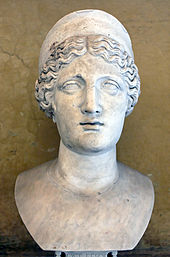
Roman copy of a Greek 5th century Hera of the "Barberini Hera" type, from the Museo Chiaramonti
In the Temple of Hera, Olympia, Hera's seated cult figure was older than the warrior figure of Zeus that accompanied it. Homer expressed her relationship with Zeus delicately in the Iliad, in which she declares to Zeus, "I am Cronus' eldest daughter, and am honourable not on this ground only, but also because I am your wife, and you are king of the gods."[26]
Matriarchy
There has been considerable scholarship, reaching back to Johann Jakob Bachofen in the mid-nineteenth century,[27] about the possibility that Hera, whose early importance in Greek religion is firmly established, was originally the goddess of a matriarchal people, presumably inhabiting Greece before the Hellenes. In this view, her activity as goddess of marriage established the patriarchal bond of her own subordination: her resistance to the conquests of Zeus is rendered as Hera's "jealousy", the main theme of literary anecdotes that undercut her ancient cult.[28]
However, it remains a controversial claim that an ancient matriarchy or a cultural focus on a monotheistic Great Goddess existed among the ancient Greeks or elsewhere. The claim is generally rejected by modern scholars as insufficiently evidenced.[29]
Origin and birth
Hera is the daughter of the youngest Titan Cronus and his wife, and sister, Rhea. Cronus was fated to be overthrown by one of his children; to prevent this, he swallowed all of his newborn children whole until Rhea tricked him into swallowing a stone instead of her youngest child, Zeus. Zeus grew up in secret and when he grew up he tricked his father into regurgitating his siblings, including Hera. Zeus then led the revolt against the Titans, banished them, and divided the dominion over the world with his brothers Poseidon and Hades.[30]
Youth
Hera was most known as the matron goddess, Hera Teleia; but she presided over weddings as well. In myth and cult, fragmentary references and archaic practices remain of the sacred marriage of Hera and Zeus.[31] At Plataea, there was a sculpture of Hera seated as a bride by Callimachus, as well as the matronly standing Hera.[32]
Hera was also worshipped as a virgin: there was a tradition in Stymphalia in Arcadia that there had been a triple shrine to Hera the Girl (Παις [Pais]), the Adult Woman (Τελεια [Teleia]), and the Separated (Χήρη [Chḗrē] 'Widowed' or 'Divorced').[33] In the region around Argos, the temple of Hera in Hermione near Argos was to Hera the Virgin.[34] At the spring of Kanathos, close to Nauplia, Hera renewed her virginity annually, in rites that were not to be spoken of (arrheton).[35] The Female figure, showing her "Moon" over the lake is also appropriate, as Hebe, Hera, and Hecate; new moon, full moon, and old moon in that order and otherwise personified as the Virgin of Spring, The Mother of Summer, and the destroying Crone of Autumn
NOW SOME INFORMATIONS ABOUT HERA IN KNOWLEDGE TO PERCY JACKSON BOOKS
| Hera | Juno |

Hera
- PJO/HoO
- Org
- GN
- GN Alt
- GG
- RR
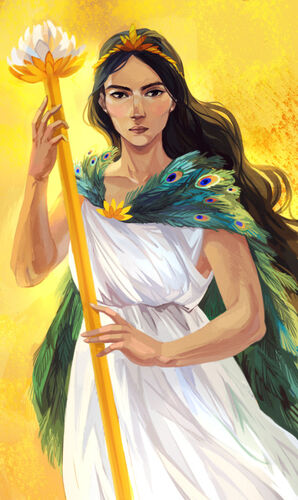
| “ | Giving you answers would make those answers invalid, that is the way of the Fates. You must forge your own path for it to mean anything. Already, you three have surprised me. I would not have thought it possible... | ” |
| –Hera, to Jason, Leo, and Piper in The Lost Hero. | ||
Contents
[show]History
Birth and Rescue
Hera was the youngest daughter and third child of Kronos, the Titan King of Mount Othrys, and his wife Rhea. Since she was their most beautiful daughter, Rhea had hoped that Hera wouldn't get swallowed. However, since Hera was a goddess (a member of a more beautiful and powerful race of immortals than the Titans), Kronos feared that Hera would one day overpower him and quickly proceeded to swallow her whole as well. Hera spent her childhood undigested in her father's stomach along with her sisters, and two younger brothers, who were swallowed shortly thereafter. Since they were immortal gods who couldn't truly die, all five of them had grown to their maturity undigested in Kronos' stomach.However, Rhea soon gave birth to her final child, Zeus, who she secretly raised on Crete far away from Mount Othrys. After growing up, Zeus successfully infiltrated Kronos' Palace on Mount Othrys disguised as the Titan King's royal cup-bearer. Hera was finally released during the final drinking competition that Kronos had with his Titanic brothers and nephews. The Titan King disgorged all of the contents of his stomach in reverse order of swallowing: first the boulder (which Rhea put in Zeus' place), then Poseidon, Hades, Hera, Demeter, and Hestia. Zeus quickly introduced himself to his elder siblings, and all of them promptly escaped Mount Othrys, before their Titanic uncles and cousins came to their senses. In Zeus' Cave, at the base of Mount Ida, Hera happily reunited with her mother, who tearfully embraced her. Shortly thereafter, Hera and the other gods accepted Zeus as their leader and reached a unanimous consensus on declaring war against their tyrannical father. However, since the Titans were well-armed, and the gods still had no weapons, Hera agreed to help Zeus release their Elder Cyclopes and Hekatonkheire uncles from Tartarus first.
Rescuing the Elder Cyclopes and Hekatonkheires
Her brother Hades was very skilled in navigating under the earth and lead them all into Tartarus through a network of Underworld tunnels. There, imprisoned in the maximum-security zone were the Elder Cyclopes and Hekatonkheires. Their guardian, Kampê, was the most ferocious and fearsome monster in all of Tartarus. However, the gods overcame their fear and were able to sneak in. Zeus managed to talk to the Cyclopes Brontes and convinced him to forge powerful weapons for him and his siblings behind Kampê's back. The three Elder Cyclopes forged three incredibly powerful weapons: the Master Bolt (for Zeus), the Trident (for Poseidon), and the Helm of Darkness (for Hades). With these new weapons, Zeus killed Kampê and Poseidon shattered the chains of the Elder Cyclopes and Hekatonkheires, releasing them. Afterward Hades safely guided his siblings and uncles back out of Tartarus. In return, for their release, all six of Hera's uncles agreed to fight on her side in the upcoming war with the Titans.The First Titanomachy
Shortly after their return from Tartarus, Hera and her siblings officially declared war on Kronos and the other Titans, which resulted in the terrifying 11-year-long Titanomachy. The Elder Cyclopes soon forged a mighty golden Lotus staff for Hera, which she bravely wielded in battle against the Titans. The Titans initially had the upper hand since they were much more experienced warriors. However, as the years passed, the gods quickly became skilled warriors as well, and with the help of their new extremely powerful weapons and the aid of the Elder Cyclopes and Hekatonkheires, the gods finally prevailed.While preparing for the final battle of the war, Hera and her siblings ascended to Mount Olympus (the tallest mountain in Greece after Mount Orthys). During the final battle, Zeus used his Master Bolt to shear off the top of Mount Othrys, and hurl Kronos from his Black Throne, defeating the Titan King. Shortly thereafter, the gods invaded the ruins of Mount Orthys and finally overwhelmed Atlas, Hyperion, Iapetus, Krios, and Koios.
In the aftermath of the battle, the Elder Cyclops chained up all of the defeated Titans, while the Hekatonkheires forced them to kneel before the gods. Zeus took their father's Scythe and sliced Kronos into a thousand pieces, before casting him into Tartarus, along with the rest of his followers (except for Atlas, who was forced to hold the sky). Calypso was punished for siding with the other Titans, Hera gave invisible servants to the Titaness so she would have some company during her imprisionment in Ogygia. The gods chose Olympus as their official residence and the Elder Cyclopes build magnificent palaces there for them all. As a result, the gods started to call themselves the "Olympians".
Living with Oceanus and Tethys
As the most beautiful Olympian goddess in creation (before Aphrodite's birth), Hera was desired by many gods and Titans. However, she had a fierce and infamous temper, would arrogantly rebuking anyone who ever tried to woo her. As a result, her mother decided to send Hera to her uncle Oceanus and aunt Tethys in order to learn to tame her temper. Hera spent a number of happy years with them away from Mount Olympus.After seeing how stable and loving Oceanus and Tethys' marriage was, Hera decided to strive for a similar one for herself. While Hera did manage to tame her infamous temper by the time of her return, many gods were still wary of openly flirting with her since she was determined to find a perfect husband for herself.
Marriage to Zeus
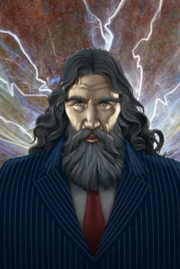 Zeus, her husband Soon after her return, Hera caught the attention of Zeus himself. While Hera had strong feelings for him as well, she refused to be another conquest for the King of the Gods. However, Zeus was just as stubborn and wouldn't be dissuaded. He applied his excellent singing, dancing, and joking skills to woo Hera, but she wouldn't initially give in. Zeus made a bet with Hera that if she would ever confess her love for him, she would become his bride. A few days later, Zeus proceeded to generate a tremendous thunderstorm around Olympus and disguised himself as an injured cuckoo. The cuckoo flew into Hera's chambers just as she was shutting her windows, and proceeded to fall on the marble floor. She took what she thought was a defenseless creature in her arms, dried its feathers, and revived it with some divine nectar. On the next morning, the cuckoo didn't seem inclined to leave, and affectionately rubbed its beak against Hera's finger. Hera admitted having grown quite fond of the bird herself and gently cuddled it in her arms. At that very instant, the cuckoo transformed into Zeus himself. Although she was embarrassed and outraged by her brother's deception, Hera was very impressed at Zeus' cleverness and agreed to become his consort on the condition that he remained loyal to her. Their wedding was held in a spectacular celebration on Mount Olympus and was attended by many gods and neutral Titans. The couple arrived on a huge golden chariot, steered by Eos (who illuminated them with brilliant rosy light), and the ceremony was lead by the Fates. Through her marriage to Zeus, Hera became the Queen of Mount Olympus and the Olympian gods. Hera received great gifts from all of their wedding guests, but her favorite was a magnificent apple tree (with golden apples) that she received from her grandmother Gaea. Hera had the tree taken far off to the west and planted in a beautiful orchard. She employed the Hesperides to guard the tree, but as the nymphs would occasionally pluck an apple from the tree themselves, she put the fierce dragon Ladon there as well. This orchard was later named the Garden of the Hesperides.The newlyweds enjoyed a wonderful honeymoon and were both very happy with each other for 300 years. They had four divine children together: Ares (the God of War), Enyo (the Goddess of War), Hebe (the Goddess of Youth), and Eileithyia (the Goddess of Childbirth). After marrying Zeus, Hera decided to became the Goddess of Marriage, Motherhood, and Familial Love. However, Zeus eventually became restless and began the first of his many affairs. Hera was infuriated and frustrated to no end by his infidelity. She devoted most of her time to keeping Zeus in sight and making the lives of his mistresses and illegitimate children miserable. Her hatred is most evident in the stories of Dionysus and Hercules, whom she tried to kill repetitively.
Birth of Hephaestus
Tired of her husband after several children without her, Hera decided to have children without him as well. Her final son was Hephaestus (God of Blacksmiths). However, when Hera saw the unsightly appearance of her son, she threw him from Olympus in fear of being embarrassed by the other gods. Hephaestus landed in the sea, where he was found and raised by the Nereid Thetis. However, Hera's act of cruelty haunted Hephaestus.After spending nine years under the sea, Hephaestus finally rode back to Mount Olympus. All of the gods (especially Hera) were shocked into silence by his ugliness. However, Hephaestus brought magnificent new thrones for all of the Olympians. Hera's throne was made from shining pure adamantine, making it particularly beautiful. A suspicious Hera finally seated herself and was instantly, tightly bound by invisible and unbreakable chains. The chains grasped Hera so tightly that she couldn't breathe and all of the divine ichor in her veins flowed to her arms and legs. Both Ares and Hermes tried to convince Hephaestus to release his mother, but the latter remained stubborn and inexorable. Dionysus began visiting Hephaestus' forge from time to time and peacefully chatting with him. A week later, Dionysus introduced Hephaestus to wine and finally convinced him to forgive Hera. Hephaestus came back to Mount Olympus, declared his forgiveness of Hera's act of cruelty and releases her. Afterwards, Hephaestus and Hera made peace with each other.
Olympian Riot
Enraged at her husband's abuse of power and infidelity, Hera decided to stage a revolt against Zeus. She managed to gain the support of Poseidon, Athena and Apollo. That evening, Apollo, Athena and Poseidon hid in the hall adjacent to the royal chambers, awaiting Hera's signal. As soon as Zeus had fallen asleep, all four of them quickly bound the King of Olympus with unbreakable and tightening golden chains. Even chained up and completely immobilized, an infuriated Zeus looked very intimidating. Poseidon attempted to reason with his brother and demanded that Zeus be a better ruler. Zeus refused, which prompted Hera to advocate leaving him chained up in his chambers until he agrees. Shortly thereafter, the four Olympians departed for the Throne Room for the first (and last) democratic meeting of the Olympian Council, which proved to be a very cumbersome task. The violent thrashing and bellowing King of Olympus was found by the Nereid Thetis. After convincing Zeus to not throwing the rioters to Tartarus, Thetis managed to find the Hekatonkheire Briares by the sea shore. Briares quickly unchained Zeus, after which the latter seized his Master Bolt, and barged into the Throne Room, violently ending the meeting.Zeus remained true to his word, but he still punished them all. Hera received the severest punishment of all: She was chained right above the terrifying Void of Chaos. Every day, Zeus would visit her, threaten to sever the chains with his Master Bolt, and watch her tumble into the Void. Hephaestus could hear the wails of his mother all the way from Mount Olympus, which infuriated him as he couldn't bear to hear her suffering such a harsh punishment. As a result, Hephaestus set his mother free with his tools. Hera tearfully embraced her son and promised to never to call him ugly ever again.
Trojan War
When Eris hurled the Apple of Discord into the wedding of Peleus and Thetis, bearing the inscription “For the fairest”, Hera was one of the candidates who competed for it. The Trojan prince Paris was chosen to judge who was the most beautiful of the three goddesses: Hera, Athena, and Aphrodite. Hera offered to make Paris the master of all Asia and Europe if he chose her. However, she lost to Aphrodite, for Paris preferred the offer of the goddess of love: the love of Helen, the most beautiful woman in the world.An enraged Hera sided with the Greeks along with Athena in the Trojan War in revenge against Paris. According to the Iliad, the war would have ended in peace, but Hera had a vested interest in its outcome and influenced Zeus to either switch sides or remain neutral.
Percy Jackson and the Olympians
The Titan's Curse
Hera is present at the Winter Solstice with the other Olympians. She votes for Percy Jackson and Thalia Grace to live.The Battle of the Labyrinth
Hera aids Percy, Annabeth Chase, Grover Underwood and Tyson in their quest multiple times by providing with food, postponing the time of Annabeth's critical decision, bribing Geryon to allow the group pass freely through the Triple G Ranch (though she removed Nico di Angelo out of the equation despite he helped the group), and guiding Percy’s arrow as it pierced Geryon's hearts.After hearing Hephaestus tell the story of how Hera threw him from Olympus and realizing how Hera was dismissive of Nico, Annabeth accuses Hera of only wanting a perfect family and claims that the goddess doesn't care about her older brother Hades' side of the family. Hera responds with rage and states that Annabeth will regret being so disrespectful towards her. She proceeds to curse Annabeth with her sacred animals, causing cows to bother her all year by having them defecate everywhere.
Hera claims that her jealous behavior is all in the past now and that she and Zeus have received some excellent marriage counseling. Nevertheless, when Percy mentions Thalia, Hera casts a dangerous look and refers to the daughter of Zeus with a sneer.
The Last Olympian
Hera joins the gods in the battle against Typhon. Meanwhile, as Olympus begins to crumble, a statue of Hera almost falls on top of Annabeth while she is running with Percy, Grover and Thalia to confront Kronos. Thalia pushes Annabeth out of the way in time, but the statue lands on her legs and incapacitates her. Annabeth assumes that Hera was trying to kill her, but this could just be an overreaction.After the Battle of Manhattan is over, Hera, though somewhat disdainfully, congratulates the heroes on their triumph. She seems to force Ares to thank them as well, showing that she is grateful to them despite her general dislike of demigods.
The Heroes of Olympus
The Lost Hero
Before the book begins, the goddess Khione lures Hera into a trap where she is ensnared in a cage that utilizes her power to awaken Porphyrion, and consequently, Gaea. She mostly appears in dreams and visions to convince Jason Grace, Piper McLean, and Leo Valdez to free her.The visions Leo sees of her are in the form of his old psychotic babysitter, Tía Callida who tried to kill Leo several times, to prepare him for his destiny as a hero. She put him in a burning fireplace when he was two, let him play with knives when he was three, and when he was four she handed him a rattlesnake. When she babysat him the last time, Leo drew a picture of a boat that was blown away by the wind, to which Tía said, "It isn't time yet, little hero." The ship that he drew was the Argo II, which he later built. Tía Callida was actually Hera.
Piper uses her charmspeak to lull Gaea to sleep, making it easier for Leo to cut through Gaea’s connection to the cage. Meanwhile, Porphyrion awakens and battles Jason, but not before greeting Hera. Leo and Piper manage to free Hera, and she orders the demigods to shut their eyes as she transforms into her true divine form, unleashing her power which kills the monsters, restores the Wolf House to its previous state, and revives the Hunters from their frozen state. However, Jason does not close his eyes in time and nearly dies, but Piper manages to bring him back by using her charmspeak and ordering him to wake up. The reason for Jason’s return to life, though, could probably be the imprisonment of Death.
Thalia and Hera have a short argument, but Piper intervenes. Hera transports the three campers back to Camp Half Blood. Later, Hera explains to Jason that he and Thalia had to be separated as their situation ― a child of Greece and Rome born into the same family ― is both dangerous and previously unknown of. She admits to Jason that she is so bitter towards heroes because she does not have any of her own demigod children, and her own godly sons, Ares and Hephaestus, are both disappointments. She also confesses to often never understanding Zeus' moods, but that his current actions are baffling even to her, bordering on paranoia. She reveals that she is Jason's patron goddess, whether Jason likes it or not.
The Son of Neptune
Juno introduces Percy Jackson to the campers as a son of Neptune, and shows her godly form to everyone in camp. The campers bow in respect with the exception of Percy, who doesn't feel she deserves his respect because he had to carry her for so long, almost getting killed along the way. Percy asks her for his life and memory back, but she declines saying he has to succeed at camp before handing him over to the Roman campers and disappearing in a shimmer of light.Hera reappears in Percy's dream to talk with him and answer a few of his questions with no ill will, despite his aggressiveness. She is far more patient with Percy than before only complaining when he tried to attack her and never showing any signs of anger. She warns him that Annabeth will be the one to cause the most trouble in the future, though the heroine helped greatly in the next battles.
The Mark of Athena
Because of the fighting between the Roman and Greek demigods of Camp Jupiter and Camp Half-Blood respectively, the gods become furious with Hera and she flees Olympus.The Blood of Olympus
When Jason, Piper and Annabeth clear the palace of Odysseus of suitors, Hera is able to appear because of the sacred marriage bed. She and Annabeth start to fight, but in the end she confirms the group's suspicions before vanishing.When Reyna, with the help of six pegasi, finally managed to place the Athena Parthenos on Half-Blood Hill, golden light ripples across the ground, seeping warmth into the bones of both Greek and Roman demigods, and curing all of the Olympians (including Hera) of their split personalities. As a result, Hera promptly arrives in Athens and re-joins her fellow Olympians in the final battle with the Giants, riding a golden chariot pulled by enormous and extremely bright peacocks. After the battle, Hera was seen having what Jason thinks is "an intense discussion" with Demeter and Poseidon.
Afterwards, Zeus confronted his wife for what she had done, claiming that her interpretation of the Prophecy of Seven and subsequently taking it into her own hands led to the inevitable conclusion of the war against the Giants. Despite her being clearly frightened by her husband's accusations, he still forgave her on account of his understanding that she had acted with truly good intentions.
The Trials of Apollo
The Hidden Oracle
Apollo mentions Hera when thinking of how she and the other Olympians stood by and watched as Zeus turned him mortal for a third time.The Tyrant's Tomb
Apollo mentions her when carrying the coffin of Jason Grace to Camp Jupiter, remembering a time when she had him carry a throne around her living room until it was in the spot she wanted it to be.| “ | Giving you answers would make those answers invalid, that is the way of the Fates. You must forge your own path for it to mean anything. Already, you three have surprised me. I would not have thought it possible... | ” |
| –Hera, to Jason, Leo, and Piper in The Lost Hero. | ||
Contents
[show]
THE LOVE GODDESS
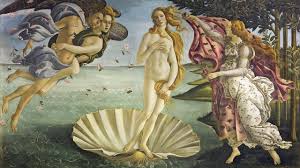
Aphrodite
Aphrodite[a] is an ancient Greek goddess associated with love, beauty, pleasure, passion and procreation. She was syncretized with the Roman goddess Venus. Aphrodite's major symbols include myrtles, roses, doves, sparrows, and swans. The cult of Aphrodite was largely derived from that of the Phoenician goddess Astarte, a cognate of the East Semitic goddess Ishtar, whose cult was based on the Sumerian cult of Inanna. Aphrodite's main cult centers were Cythera, Cyprus, Corinth, and Athens. Her main festival was the Aphrodisia, which was celebrated annually in midsummer. In Laconia, Aphrodite was worshipped as a warrior goddess. She was also the patron goddess of prostitutes, an association which led early scholars to propose the concept of "sacred prostitution" in Greco-Roman culture, an idea which is now generally seen as erroneous.
In Hesiod's Theogony, Aphrodite is born off the coast of Cythera from the foam (aphrós) produced by Uranus's genitals, which his son Cronus has severed and thrown into the sea. In Homer's Iliad, however, she is the daughter of Zeus and Dione. Plato, in his Symposium 180e, asserts that these two origins actually belong to separate entities: Aphrodite Ourania (a transcendent, "Heavenly" Aphrodite) and Aphrodite Pandemos (Aphrodite common to "all the people"). Aphrodite had many other epithets, each emphasizing a different aspect of the same goddess, or used by a different local cult. Thus she was also known as Cytherea (Lady of Cythera) and Cypris (Lady of Cyprus), because both locations claimed to be the place of her birth.
In Greek mythology, Aphrodite was married to Hephaestus, the god of blacksmiths and metalworking. Despite this, Aphrodite was frequently unfaithful to him and had many lovers; in the Odyssey, she is caught in the act of adultery with Ares, the god of war. In the First Homeric Hymn to Aphrodite, she seduces the mortal shepherd Anchises. Aphrodite was also the surrogate mother and lover of the mortal shepherd Adonis, who was killed by a wild boar. Along with Athena and Hera, Aphrodite was one of the three goddesses whose feud resulted in the beginning of the Trojan War and she plays a major role throughout the Iliad. Aphrodite has been featured in Western art as a symbol of female beauty and has appeared in numerous works of Western literature. She is a major deity in modern Neopagan religions, including the Church of Aphrodite, Wicca, and Hellenismos.
Near Eastern love goddess
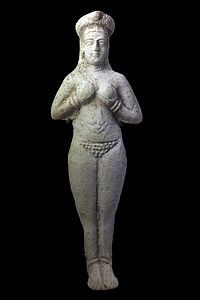 Late second-millennium BC nude figurine of Ishtar from Susa, showing her wearing a crown and clutching her breasts
Early fifth-century BC statue of Aphrodite from Cyprus, showing her wearing a cylinder crown and holding a dove
The cult of Aphrodite in Greece was imported from, or at least influenced by, the cult of Astarte in Phoenicia,[21][22][23][24] which, in turn, was influenced by the cult of the Mesopotamian goddess known as "Ishtar" to the East Semitic peoples and as "Inanna" to the Sumerians.[25][23][24] Pausanias states that the first to establish a cult of Aphrodite were the Assyrians, followed by the Paphians of Cyprus and then the Phoenicians at Ascalon. The Phoenicians, in turn, taught her worship to the people of Cythera.[26]
Aphrodite took on Inanna-Ishtar's associations with sexuality and procreation.[27] Furthermore, she was known as Ourania (Οὐρανία), which means "heavenly",[28] a title corresponding to Inanna's role as the Queen of Heaven.[28][29] Early artistic and literary portrayals of Aphrodite are extremely similar on Inanna-Ishtar.[27] Like Inanna-Ishtar, Aphrodite was also a warrior goddess;[27][22][30] the second-century AD Greek geographer Pausanias records that, in Sparta, Aphrodite was worshipped as Aphrodite Areia, which means "warlike".[31][32] He also mentions that Aphrodite's most ancient cult statues in Sparta and on Cythera showed her bearing arms.[31][32][33][27] Modern scholars note that Aphrodite's warrior-goddess aspects appear in the oldest strata of her worship[34] and see it as an indication of her Near Eastern origins.[34][35]
Nineteenth century classical scholars had a general aversion to the idea that ancient Greek religion was at all influenced by the cultures of the Near East,[36] but, even Friedrich Gottlieb Welcker, who argued that Near Eastern influence on Greek culture was largely confined to material culture,[36] admitted that Aphrodite was clearly of Phoenician origin.[36] The significant influence of Near Eastern culture on early Greek religion in general, and on the cult of Aphrodite in particular,[37] is now widely recognized as dating to a period of orientalization during the eighth century BC,[37] when archaic Greece was on the fringes of the Neo-Assyrian Empire.[38]
Indo-European dawn goddess
Some early comparative mythologists opposed to the idea of a Near Eastern origin argued that Aphrodite originated as an aspect of the Greek dawn goddess Eos[39][40] and that she was therefore ultimately derived from the Proto-Indo-European dawn goddess *Haéusōs (properly Greek Eos, Latin Aurora, Sanskrit Ushas).[39][40] Most modern scholars have now rejected the notion of a purely Indo-European Aphrodite,[6][41][14][42] but it is possible that Aphrodite, originally a Semitic deity, may have been influenced by the Indo-European dawn goddess.[42] Both Aphrodite and Eos were known for their erotic beauty and aggressive sexuality[40] and both had relationships with mortal lovers.[40] Both goddesses were associated with the colors red, white, and gold.[40] Michael Janda etymologizes Aphrodite's name as an epithet of Eos meaning "she who rises from the foam [of the ocean]"[11] and points to Hesiod's Theogony account of Aphrodite's birth as an archaic reflex of Indo-European myth.[11] Aphrodite rising out of the waters after Cronus defeats Uranus as a mytheme would then be directly cognate to the Rigvedic myth of Indra defeating Vrtra, liberating Ushas.[10][11] Another key similarity between Aphrodite and the Indo-European dawn goddess is her close kinship to the Greek sky deity,[42] since both of the main claimants to her paternity (Zeus and Uranus) are sky deities.[43]
Forms and epithets
Aphrodite Ourania, draped rather than nude, with her foot resting on a tortoise (Louvre)
Ancient Greek herma of Aphroditus, a male form of Aphrodite,[44][45][46] currently held in the Nationalmuseum in Stockholm
See also: Category:Epithets of Aphrodite
Aphrodite's most common cultic epithet was Ourania, meaning "heavenly",[47][48] but this epithet almost never occurs in literary texts, indicating a purely cultic significance.[49] Another common name for Aphrodite was Pandemos ("For All the Folk").[50] In her role as Aphrodite Pandemos, Aphrodite was associated with Peithō (Πείθω), meaning "persuasion",[51] and could be prayed to for aid in seduction.[51] The character of Pausanias in Plato's Symposium, takes differing cult-practices associated with different epithets of the goddess to claim that Ourania and Pandemos are, in fact, separate goddesses. He asserts that Aphrodite Ourania is the celestial Aphrodite, born from the sea foam after Cronus castrated Uranus, and the older of the two goddesses. According to the Symposium, Aphrodite Ourania is the inspiration of male homosexual desire, specifically the ephebic eros, and pederasty. Aphrodite Pandemos, by contrast, is the younger of the two goddesses: the common Aphrodite, born from the union of Zeus and Dione, and the inspiration of heterosexual desire and sexual promiscuity, the "lesser" of the two loves.[52][53] Paphian (Παφία), was one of her epithets, after the Paphos in Cyprus where she had emerged from the sea at her birth.[54]
Among the Neoplatonists and, later, their Christian interpreters, Ourania is associated with spiritual love, and Pandemos with physical love (desire). A representation of Ourania with her foot resting on a tortoise came to be seen as emblematic of discretion in conjugal love; it was the subject of a chryselephantine sculpture by Phidias for Elis, known only from a parenthetical comment by the geographer Pausanias.[55]
One of Aphrodite's most common literary epithets is Philommeidḗs (φιλομμειδής),[56] which means "smile-loving",[56] but is sometimes mistranslated as "laughter-loving".[56] This epithet occurs throughout both of the Homeric epics and the First Homeric Hymn to Aphrodite.[56] Hesiod references it once in his Theogony in the context of Aphrodite's birth,[57] but interprets it as "genital-loving" rather than "smile-loving".[57] Monica Cyrino notes that the epithet may relate to the fact that, in many artistic depictions of Aphrodite, she is shown smiling.[57] Other common literary epithets are Cypris and Cythereia,[58] which derive from her associations with the islands of Cyprus and Cythera respectively.[58]
On Cyprus, Aphrodite was sometimes called Eleemon ("the merciful").[48] In Athens, she was known as Aphrodite en kopois ("Aphrodite of the Gardens").[48] At Cape Colias, a town along the Attic coast, she was venerated as Genetyllis "Mother".[48] The Spartans worshipped her as Potnia "Mistress", Enoplios "Armed", Morpho "Shapely", Ambologera "She who Postpones Old Age".[48] Across the Greek world, she was known under epithets such as Melainis "Black One", Skotia "Dark One", Androphonos "Killer of Men", Anosia "Unholy", and Tymborychos "Gravedigger",[46] all of which indicate her darker, more violent nature.[46]
A male version of Aphrodite known as Aphroditus was worshipped in the city of Amathus on Cyprus.[44][45][46] Aphroditus was depicted with the figure and dress of a woman,[44][45] but had a beard,[44][45] and was shown lifting his dress to reveal an erect phallus.[44][45] This gesture was believed to be an apotropaic symbol,[59] and was thought to convey good fortune upon the viewer.[59] Eventually, the popularity of Aphroditus waned as the mainstream, fully feminine version of Aphrodite became more popular,[45] but traces of his cult are preserved in the later legends of Hermaphroditus.[45]
Worship
Classical period
Ruins of the temple of Aphrodite at Aphrodisias
Aphrodite's main festival, the Aphrodisia, was celebrated across Greece, but particularly in Athens and Corinth. In Athens, the Aphrodisia was celebrated on the fourth day of the month of Hekatombaion in honor of Aphrodite's role in the unification of Attica.[60][61] During this festival, the priests of Aphrodite would purify the temple of Aphrodite Pandemos on the southwestern slope of the Acropolis with the blood of a sacrificed dove.[62] Next, the altars would be anointed[62] and the cult statues of Aphrodite Pandemos and Peitho would be escorted in a majestic procession to a place where they would be ritually bathed.[63] Aphrodite was also honored in Athens as part of the Arrhephoria festival.[64] The fourth day of every month was sacred to Aphrodite.[65]
Pausanias records that, in Sparta, Aphrodite was worshipped as Aphrodite Areia, which means "warlike".[31][32] This epithet stresses Aphrodite's connections to Ares, with whom she had extramarital relations.[31][32] Pausanias also records that, in Sparta[31][32] and on Cythera, a number of extremely ancient cult statues of Aphrodite portrayed her bearing arms.[33][48] Other cult statues showed her bound in chains.[48]
Aphrodite was the patron goddess of prostitutes of all varieties,[66][48] ranging from pornai (cheap street prostitutes typically owned as slaves by wealthy pimps) to hetairai (expensive, well-educated hired companions, who were usually self-employed and sometimes provided sex to their customers).[67] The city of Corinth was renowned throughout the ancient world for its many hetairai,[68] who had a widespread reputation for being among the most skilled, but also the most expensive, prostitutes in the Greek world.[68] Corinth also had a major temple to Aphrodite located on the Acrocorinth[68] and was one of the main centers of her cult.[68] Records of numerous dedications to Aphrodite made by successful courtesans have survived in poems and in pottery inscriptions.[67] References to Aphrodite in association with prostitution are found in Corinth as well as on the islands of Cyprus, Cythera, and Sicily.[69] Aphrodite's Mesopotamian precursor Inanna-Ishtar was also closely associated with prostitution.[70][71][69]
Scholars in the nineteenth and twentieth centuries believed that the cult of Aphrodite may have involved ritual prostitution,[71][69] an assumption based on ambiguous passages in certain ancient texts, particularly a fragment of a skolion by the Boeotian poet Pindar,[72] which mentions prostitutes in Corinth in association with Aphrodite.[72] Modern scholars now dismiss the notion of ritual prostitution in Greece as a "historiographic myth" with no factual basis.[73]
Hellenistic and Roman periods

Greek relief from Aphrodisias, depicting a Roman-influenced Aphrodite sitting on a throne holding an infant while the shepherd Anchises stands beside her. Carlos Delgado; CC-BY-SA.
During the Hellenistic period, the Greeks identified Aphrodite with the ancient Egyptian goddesses Hathor and Isis.[74][75][76] Aphrodite was the patron goddess of the Lagid queens[77] and Queen Arsinoe II was identified as her mortal incarnation.[77] Aphrodite was worshipped in Alexandria[77] and had numerous temples in and around the city.[77] Arsinoe II introduced the cult of Adonis to Alexandria and many of the women there partook in it.[77] The Tessarakonteres, a gigantic catamaran galley designed by Archimedes for Ptolemy IV Philopator, had a circular temple to Aphrodite on it with a marble statue of the goddess herself.[77] In the second century BC, Ptolemy VIII Physcon and his wives Cleopatra II and Cleopatra III dedicated a temple to Aphrodite Hathor at Philae.[77] Statuettes of Aphrodite for personal devotion became common in Egypt starting in the early Ptolemaic times and extending until long after Egypt became a Roman province.[77]
The ancient Romans identified Aphrodite with their goddess Venus,[78] who was originally a goddess of agricultural fertility, vegetation, and springtime.[78] According to the Roman historian Livy, Aphrodite and Venus were officially identified in the third century BC[79] when the cult of Venus Erycina was introduced to Rome from the Greek sanctuary of Aphrodite on Mount Eryx in Sicily.[79] After this point, Romans adopted Aphrodite's iconography and myths and applied them to Venus.[79] Because Aphrodite was the mother of the Trojan hero Aeneas in Greek mythology[79] and Roman tradition claimed Aeneas as the founder of Rome,[79] Venus became venerated as Venus Genetrix, the mother of the entire Roman nation.[79] Julius Caesar claimed to be directly descended from Aeneas's son Iulus[80] and became a strong proponent of the cult of Venus.[80] This precedent was later followed by his nephew Augustus and the later emperors claiming succession from him.[80]
This syncretism greatly impacted Greek worship of Aphrodite.[81] During the Roman era, the cults of Aphrodite in many Greek cities began to emphasize her relationship with Troy and Aeneas.[81] They also began to adopt distinctively Roman elements,[81] portraying Aphrodite as more maternal, more militaristic, and more concerned with administrative bureaucracy.[81] She was claimed as a divine guardian by many political magistrates.[81] Appearances of Aphrodite in Greek literature also vastly proliferated, usually showing Aphrodite in a characteristically Roman manner.[82]
| Goddess of love, beauty and sexuality | |
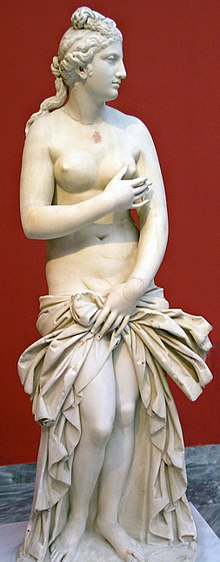 Aphrodite Pudica (Roman copy of 2nd century AD), National Archaeological Museum, Athens Aphrodite Pudica (Roman copy of 2nd century AD), National Archaeological Museum, Athens | |
| Mount Olympus | |
| Dolphin, Rose, Scallop Shell, Myrtle, Dove, Sparrow, Girdle, Mirror, Pearl and Swan | |
| In the Iliad: Zeus and Dione[2] In Theogony: Uranus's severed genitals[3] | |
| Aeacus, Angelos, Apollo, Ares, Artemis, Athena, Dionysus, Eileithyia, Enyo, Eris, Ersa, Hebe, Helen of Troy, Hephaestus, Heracles, Hermes, Minos, Pandia, Persephone, Perseus, Rhadamanthus, the Graces, the Horae, the Litae, the Muses, the Moirai, or the Titans, the Cyclopes, the Meliae, the Erinyes (Furies), the Giants, the Hekatonkheires | |
| Hephaestus, Ares, Poseidon, Hermes, Dionysus, Adonis, and Anchises | |
| With Ares: Eros,[1] Phobos, Deimos, Harmonia, Pothos, Anteros, Himeros, With Hermes: Hermaphroditus, With Poseidon: Rhodos, Eryx, With Dionysus: Peitho, The Graces, Priapus, With Anchises: Aeneas | |
| Venus | |
| Inanna/Ishtar | |
| Astarte | |
In Hesiod's Theogony, Aphrodite is born off the coast of Cythera from the foam (aphrós) produced by Uranus's genitals, which his son Cronus has severed and thrown into the sea. In Homer's Iliad, however, she is the daughter of Zeus and Dione. Plato, in his Symposium 180e, asserts that these two origins actually belong to separate entities: Aphrodite Ourania (a transcendent, "Heavenly" Aphrodite) and Aphrodite Pandemos (Aphrodite common to "all the people"). Aphrodite had many other epithets, each emphasizing a different aspect of the same goddess, or used by a different local cult. Thus she was also known as Cytherea (Lady of Cythera) and Cypris (Lady of Cyprus), because both locations claimed to be the place of her birth.
In Greek mythology, Aphrodite was married to Hephaestus, the god of blacksmiths and metalworking. Despite this, Aphrodite was frequently unfaithful to him and had many lovers; in the Odyssey, she is caught in the act of adultery with Ares, the god of war. In the First Homeric Hymn to Aphrodite, she seduces the mortal shepherd Anchises. Aphrodite was also the surrogate mother and lover of the mortal shepherd Adonis, who was killed by a wild boar. Along with Athena and Hera, Aphrodite was one of the three goddesses whose feud resulted in the beginning of the Trojan War and she plays a major role throughout the Iliad. Aphrodite has been featured in Western art as a symbol of female beauty and has appeared in numerous works of Western literature. She is a major deity in modern Neopagan religions, including the Church of Aphrodite, Wicca, and Hellenismos.
Near Eastern love goddess
Late second-millennium BC nude figurine of Ishtar from Susa, showing her wearing a crown and clutching her breastsEarly fifth-century BC statue of Aphrodite from Cyprus, showing her wearing a cylinder crown and holding a dove
The cult of Aphrodite in Greece was imported from, or at least influenced by, the cult of Astarte in Phoenicia,[21][22][23][24] which, in turn, was influenced by the cult of the Mesopotamian goddess known as "Ishtar" to the East Semitic peoples and as "Inanna" to the Sumerians.[25][23][24] Pausanias states that the first to establish a cult of Aphrodite were the Assyrians, followed by the Paphians of Cyprus and then the Phoenicians at Ascalon. The Phoenicians, in turn, taught her worship to the people of Cythera.[26]
Aphrodite took on Inanna-Ishtar's associations with sexuality and procreation.[27] Furthermore, she was known as Ourania (Οὐρανία), which means "heavenly",[28] a title corresponding to Inanna's role as the Queen of Heaven.[28][29] Early artistic and literary portrayals of Aphrodite are extremely similar on Inanna-Ishtar.[27] Like Inanna-Ishtar, Aphrodite was also a warrior goddess;[27][22][30] the second-century AD Greek geographer Pausanias records that, in Sparta, Aphrodite was worshipped as Aphrodite Areia, which means "warlike".[31][32] He also mentions that Aphrodite's most ancient cult statues in Sparta and on Cythera showed her bearing arms.[31][32][33][27] Modern scholars note that Aphrodite's warrior-goddess aspects appear in the oldest strata of her worship[34] and see it as an indication of her Near Eastern origins.[34][35]
Nineteenth century classical scholars had a general aversion to the idea that ancient Greek religion was at all influenced by the cultures of the Near East,[36] but, even Friedrich Gottlieb Welcker, who argued that Near Eastern influence on Greek culture was largely confined to material culture,[36] admitted that Aphrodite was clearly of Phoenician origin.[36] The significant influence of Near Eastern culture on early Greek religion in general, and on the cult of Aphrodite in particular,[37] is now widely recognized as dating to a period of orientalization during the eighth century BC,[37] when archaic Greece was on the fringes of the Neo-Assyrian Empire.[38]
Indo-European dawn goddess
Some early comparative mythologists opposed to the idea of a Near Eastern origin argued that Aphrodite originated as an aspect of the Greek dawn goddess Eos[39][40] and that she was therefore ultimately derived from the Proto-Indo-European dawn goddess *Haéusōs (properly Greek Eos, Latin Aurora, Sanskrit Ushas).[39][40] Most modern scholars have now rejected the notion of a purely Indo-European Aphrodite,[6][41][14][42] but it is possible that Aphrodite, originally a Semitic deity, may have been influenced by the Indo-European dawn goddess.[42] Both Aphrodite and Eos were known for their erotic beauty and aggressive sexuality[40] and both had relationships with mortal lovers.[40] Both goddesses were associated with the colors red, white, and gold.[40] Michael Janda etymologizes Aphrodite's name as an epithet of Eos meaning "she who rises from the foam [of the ocean]"[11] and points to Hesiod's Theogony account of Aphrodite's birth as an archaic reflex of Indo-European myth.[11] Aphrodite rising out of the waters after Cronus defeats Uranus as a mytheme would then be directly cognate to the Rigvedic myth of Indra defeating Vrtra, liberating Ushas.[10][11] Another key similarity between Aphrodite and the Indo-European dawn goddess is her close kinship to the Greek sky deity,[42] since both of the main claimants to her paternity (Zeus and Uranus) are sky deities.[43]
Forms and epithets
Aphrodite Ourania, draped rather than nude, with her foot resting on a tortoise (Louvre)
Ancient Greek herma of Aphroditus, a male form of Aphrodite,[44][45][46] currently held in the Nationalmuseum in Stockholm
See also: Category:Epithets of Aphrodite
Aphrodite's most common cultic epithet was Ourania, meaning "heavenly",[47][48] but this epithet almost never occurs in literary texts, indicating a purely cultic significance.[49] Another common name for Aphrodite was Pandemos ("For All the Folk").[50] In her role as Aphrodite Pandemos, Aphrodite was associated with Peithō (Πείθω), meaning "persuasion",[51] and could be prayed to for aid in seduction.[51] The character of Pausanias in Plato's Symposium, takes differing cult-practices associated with different epithets of the goddess to claim that Ourania and Pandemos are, in fact, separate goddesses. He asserts that Aphrodite Ourania is the celestial Aphrodite, born from the sea foam after Cronus castrated Uranus, and the older of the two goddesses. According to the Symposium, Aphrodite Ourania is the inspiration of male homosexual desire, specifically the ephebic eros, and pederasty. Aphrodite Pandemos, by contrast, is the younger of the two goddesses: the common Aphrodite, born from the union of Zeus and Dione, and the inspiration of heterosexual desire and sexual promiscuity, the "lesser" of the two loves.[52][53] Paphian (Παφία), was one of her epithets, after the Paphos in Cyprus where she had emerged from the sea at her birth.[54]
Among the Neoplatonists and, later, their Christian interpreters, Ourania is associated with spiritual love, and Pandemos with physical love (desire). A representation of Ourania with her foot resting on a tortoise came to be seen as emblematic of discretion in conjugal love; it was the subject of a chryselephantine sculpture by Phidias for Elis, known only from a parenthetical comment by the geographer Pausanias.[55]
One of Aphrodite's most common literary epithets is Philommeidḗs (φιλομμειδής),[56] which means "smile-loving",[56] but is sometimes mistranslated as "laughter-loving".[56] This epithet occurs throughout both of the Homeric epics and the First Homeric Hymn to Aphrodite.[56] Hesiod references it once in his Theogony in the context of Aphrodite's birth,[57] but interprets it as "genital-loving" rather than "smile-loving".[57] Monica Cyrino notes that the epithet may relate to the fact that, in many artistic depictions of Aphrodite, she is shown smiling.[57] Other common literary epithets are Cypris and Cythereia,[58] which derive from her associations with the islands of Cyprus and Cythera respectively.[58]
On Cyprus, Aphrodite was sometimes called Eleemon ("the merciful").[48] In Athens, she was known as Aphrodite en kopois ("Aphrodite of the Gardens").[48] At Cape Colias, a town along the Attic coast, she was venerated as Genetyllis "Mother".[48] The Spartans worshipped her as Potnia "Mistress", Enoplios "Armed", Morpho "Shapely", Ambologera "She who Postpones Old Age".[48] Across the Greek world, she was known under epithets such as Melainis "Black One", Skotia "Dark One", Androphonos "Killer of Men", Anosia "Unholy", and Tymborychos "Gravedigger",[46] all of which indicate her darker, more violent nature.[46]
A male version of Aphrodite known as Aphroditus was worshipped in the city of Amathus on Cyprus.[44][45][46] Aphroditus was depicted with the figure and dress of a woman,[44][45] but had a beard,[44][45] and was shown lifting his dress to reveal an erect phallus.[44][45] This gesture was believed to be an apotropaic symbol,[59] and was thought to convey good fortune upon the viewer.[59] Eventually, the popularity of Aphroditus waned as the mainstream, fully feminine version of Aphrodite became more popular,[45] but traces of his cult are preserved in the later legends of Hermaphroditus.[45]
Worship
Classical period
Ruins of the temple of Aphrodite at Aphrodisias
Aphrodite's main festival, the Aphrodisia, was celebrated across Greece, but particularly in Athens and Corinth. In Athens, the Aphrodisia was celebrated on the fourth day of the month of Hekatombaion in honor of Aphrodite's role in the unification of Attica.[60][61] During this festival, the priests of Aphrodite would purify the temple of Aphrodite Pandemos on the southwestern slope of the Acropolis with the blood of a sacrificed dove.[62] Next, the altars would be anointed[62] and the cult statues of Aphrodite Pandemos and Peitho would be escorted in a majestic procession to a place where they would be ritually bathed.[63] Aphrodite was also honored in Athens as part of the Arrhephoria festival.[64] The fourth day of every month was sacred to Aphrodite.[65]
Pausanias records that, in Sparta, Aphrodite was worshipped as Aphrodite Areia, which means "warlike".[31][32] This epithet stresses Aphrodite's connections to Ares, with whom she had extramarital relations.[31][32] Pausanias also records that, in Sparta[31][32] and on Cythera, a number of extremely ancient cult statues of Aphrodite portrayed her bearing arms.[33][48] Other cult statues showed her bound in chains.[48]
Aphrodite was the patron goddess of prostitutes of all varieties,[66][48] ranging from pornai (cheap street prostitutes typically owned as slaves by wealthy pimps) to hetairai (expensive, well-educated hired companions, who were usually self-employed and sometimes provided sex to their customers).[67] The city of Corinth was renowned throughout the ancient world for its many hetairai,[68] who had a widespread reputation for being among the most skilled, but also the most expensive, prostitutes in the Greek world.[68] Corinth also had a major temple to Aphrodite located on the Acrocorinth[68] and was one of the main centers of her cult.[68] Records of numerous dedications to Aphrodite made by successful courtesans have survived in poems and in pottery inscriptions.[67] References to Aphrodite in association with prostitution are found in Corinth as well as on the islands of Cyprus, Cythera, and Sicily.[69] Aphrodite's Mesopotamian precursor Inanna-Ishtar was also closely associated with prostitution.[70][71][69]
Scholars in the nineteenth and twentieth centuries believed that the cult of Aphrodite may have involved ritual prostitution,[71][69] an assumption based on ambiguous passages in certain ancient texts, particularly a fragment of a skolion by the Boeotian poet Pindar,[72] which mentions prostitutes in Corinth in association with Aphrodite.[72] Modern scholars now dismiss the notion of ritual prostitution in Greece as a "historiographic myth" with no factual basis.[73]
Hellenistic and Roman periods

Greek relief from Aphrodisias, depicting a Roman-influenced Aphrodite sitting on a throne holding an infant while the shepherd Anchises stands beside her. Carlos Delgado; CC-BY-SA.
During the Hellenistic period, the Greeks identified Aphrodite with the ancient Egyptian goddesses Hathor and Isis.[74][75][76] Aphrodite was the patron goddess of the Lagid queens[77] and Queen Arsinoe II was identified as her mortal incarnation.[77] Aphrodite was worshipped in Alexandria[77] and had numerous temples in and around the city.[77] Arsinoe II introduced the cult of Adonis to Alexandria and many of the women there partook in it.[77] The Tessarakonteres, a gigantic catamaran galley designed by Archimedes for Ptolemy IV Philopator, had a circular temple to Aphrodite on it with a marble statue of the goddess herself.[77] In the second century BC, Ptolemy VIII Physcon and his wives Cleopatra II and Cleopatra III dedicated a temple to Aphrodite Hathor at Philae.[77] Statuettes of Aphrodite for personal devotion became common in Egypt starting in the early Ptolemaic times and extending until long after Egypt became a Roman province.[77]
The ancient Romans identified Aphrodite with their goddess Venus,[78] who was originally a goddess of agricultural fertility, vegetation, and springtime.[78] According to the Roman historian Livy, Aphrodite and Venus were officially identified in the third century BC[79] when the cult of Venus Erycina was introduced to Rome from the Greek sanctuary of Aphrodite on Mount Eryx in Sicily.[79] After this point, Romans adopted Aphrodite's iconography and myths and applied them to Venus.[79] Because Aphrodite was the mother of the Trojan hero Aeneas in Greek mythology[79] and Roman tradition claimed Aeneas as the founder of Rome,[79] Venus became venerated as Venus Genetrix, the mother of the entire Roman nation.[79] Julius Caesar claimed to be directly descended from Aeneas's son Iulus[80] and became a strong proponent of the cult of Venus.[80] This precedent was later followed by his nephew Augustus and the later emperors claiming succession from him.[80]
This syncretism greatly impacted Greek worship of Aphrodite.[81] During the Roman era, the cults of Aphrodite in many Greek cities began to emphasize her relationship with Troy and Aeneas.[81] They also began to adopt distinctively Roman elements,[81] portraying Aphrodite as more maternal, more militaristic, and more concerned with administrative bureaucracy.[81] She was claimed as a divine guardian by many political magistrates.[81] Appearances of Aphrodite in Greek literature also vastly proliferated, usually showing Aphrodite in a characteristically Roman manner.[82]
ARES THE ONE
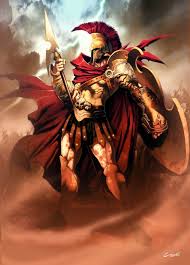

Ares
Jump to navigation Jump to search This article is about the ancient Greek god. For other uses, see Ares (disambiguation). Not to be confused with Aries (astrology). AresAbodeSymbolsPersonal informationParentsSiblingsConsortChildrenRoman equivalentNorse equivalentHinduism equivalent
Ancient Greek religion
Ares (/ˈɛəriːz/; Ancient Greek: Ἄρης, Áres [árɛːs]) is the Greek god of war. He is one of the Twelve Olympians, and the son of Zeus and Hera.[1] In Greek literature, he often represents the physical or violent and untamed aspect of war and is the personification of sheer brutality, in contrast to his sister, the armored Athena, whose functions as a goddess of intelligence include military strategy and generalship.[2]
The Greeks were ambivalent toward Ares: although he embodied the physical valor necessary for success in war, he was a dangerous force, "overwhelming, insatiable in battle, destructive, and man-slaughtering."[3] His sons Phobos (Fear) and Deimos (Terror) and his lover, or sister, Enyo (Discord) accompanied him on his war chariot.[4] In the Iliad, his father Zeus tells him that he is the god most hateful to him.[5] An association with Ares endows places and objects with a savage, dangerous, or militarized quality.[6] His value as a war god is placed in doubt: during the Trojan War, Ares was on the losing side, while Athena, often depicted in Greek art as holding Nike (Victory) in her hand, favoured the triumphant Greeks.[3]
Ares plays a relatively limited role in Greek mythology as represented in literary narratives, though his numerous love affairs and abundant offspring are often alluded to.[7] When Ares does appear in myths, he typically faces humiliation.[8] He is well known as the lover of Aphrodite, the goddess of love, who was married to Hephaestus, god of craftsmanship.[9] The most famous story related to Ares and Aphrodite shows them exposed to ridicule through the wronged husband's device.[10]
The counterpart of Ares among the Roman gods is Mars,[11] who as a father of the Roman people was given a more important and dignified place in ancient Roman religion as a guardian deity. During the Hellenization of Latin literature, the myths of Ares were reinterpreted by Roman writers under the name of Mars. Greek writers under Roman rule also recorded cult practices and beliefs pertaining to Mars under the name of Ares. Thus in the classical tradition of later Western art and literature, the mythology of the two figures later became virtually indistinguishable.
The etymology of the name Ares is traditionally connected with the Greek word ἀρή (arē), the Ionic form of the Doric ἀρά (ara), "bane, ruin, curse, imprecation".[12] There may also be a connection with the Roman god of war, Mars, via hypothetical Proto-Indo-European *M̥rēs;[citation needed] compare Ancient Greek μάρναμαι (marnamai), "I fight, I battle".[13] Walter Burkert notes that "Ares is apparently an ancient abstract noun meaning throng of battle, war."[14] R. S. P. Beekes has suggested a Pre-Greek origin of the name.[15]
The earliest attested form of the name is the Mycenaean Greek 𐀀𐀩, a-re, written in the Linear B syllabic script.[16][17][18]
The adjectival epithet, Areios, was frequently appended to the names of other gods when they took on a warrior aspect or became involved in warfare: Zeus Areios, Athena Areia, even Aphrodite Areia. In the Iliad, the word ares is used as a common noun synonymous with "battle."[3]
Inscriptions as early as Mycenaean times, and continuing into the Classical period, attest to Enyalios as another name for the god of war.[n 1]
Character, origins, and worship
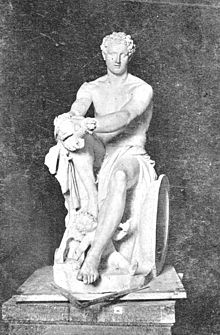
Vatican, Rome, Italy. Statue of Ares, Scopas's influence. Brooklyn Museum Archives, Goodyear Archival Collection
Ares was one of the Twelve Olympians in the archaic tradition represented by the Iliad and Odyssey. Zeus expresses a recurring Greek revulsion toward the god when Ares returns wounded and complaining from the battlefield at Troy:
Then looking at him darkly Zeus who gathers the clouds spoke to him:
"Do not sit beside me and whine, you double-faced liar.
To me you are the most hateful of all gods who hold Olympus.
Forever quarrelling is dear to your heart, wars and battles.
...
And yet I will not long endure to see you in pain, since
you are my child, and it was to me that your mother bore you.
But were you born of some other god and proved so ruinous
long since you would have been dropped beneath the gods of the bright sky."[21]
This ambivalence is expressed also in the Greeks' association of Ares with the Thracians, whom they regarded as a barbarous and warlike people.[22] Thrace was Ares's birthplace, his true home, and his refuge after the affair with Aphrodite was exposed to the general mockery of the other gods.[n 2]
A late-6th-century BC funerary inscription from Attica emphasizes the consequences of coming under Ares's sway:
Stay and mourn at the tomb of dead Kroisos
Whom raging Ares destroyed one day, fighting in the foremost ranks.[23]
Ares in Sparta
In Sparta, Ares was viewed as a model soldier: his resilience, physical strength, and military intelligence were unrivaled. An ancient statue, representing the god in chains, suggests that the martial spirit and victory were to be kept in the city of Sparta. That the Spartans admired him is indicative of the cultural divisions that existed between themselves and other Greeks, especially the Athenians (see Pelopponesian War).
Ares in the Arabian Peninsula
Ares was also worshipped by the inhabitants of Tylos. It is not known if he was worshipped in the form of an Arabian god (or which one) or if he was worshipped in his Greek form.[24]
Ares in the Scythians
According to Herodotus' Histories, the Scythians worshipped a god he equated with the Greek Ares; unlike most other Scythian gods, he does not offer the indigenous name for this deity. While ranking beneath Tabiti, Api and Papaios in the divine hierarchy, this god was apparently worshipped differently from other Scythian gods, with statues and complex altars devoted to him. This type of worship is noted to be present among the Alans.[25]
Noting how Greek mythological Amazons are devotees of Ares and most likely based on Scythian warriors, some researchers have considered the possibility that a Scythian warrior women cult of this deity existed.[26] Others have also posited that the "Sword of Mars" alludes to the Huns having adopted this deity.[27]
Ares in Ethiopia
Maḥrem, the principal god of the kings of Aksum prior to the 4th century AD, was always equated with Ares. In their Greek inscriptions, the kings invoke Ares. In bilingual inscriptions, where the Ethiopic has Maḥrem the Greek will have Ares. The anonymous king who put up the Monumentum Adulitanum in the late 2nd or early 3rd century refers to "my greatest god, Ares, who also begat me, through whom I brought under my sway" various peoples. The monumental throne celebrating the king's conquests was itself dedicated to Ares.[28] In the early 4th century, the last pagan king of Aksum, Ezana, referred to "the one who brought me forth, the invincible Ares".[29]
Attributes
The Ares Borghese.
Ares’ attributes were a helmet, shield, and sword or spear.[30] The birds of Ares (Ornithes Areioi) were a flock of feather-dart-dropping birds that guarded the Amazons' shrine of the god on a coastal island in the Black Sea.[31]
Cult and ritual
Although Ares received occasional sacrifice from armies going to war, the god had a formal temple and cult at only a few sites.[32] At Sparta, however, each company of youths sacrificed a puppy to Enyalios before engaging in ritual fighting at the Phoebaeum.[n 3] The chthonic night-time sacrifice of a dog to Enyalios became assimilated to the cult of Ares.[34]
Just east of Sparta stood an archaic statue of Ares in chains, to show that the spirit of war and victory was to be kept in the city.[n 4]
The Temple of Ares in the agora of Athens, which Pausanias saw in the second century AD, had been moved and rededicated there during the time of Augustus. Essentially, it was a Roman temple to the Augustan Mars Ultor.[32] From archaic times, the Areopagus, the "mount of Ares" at some distance from the Acropolis, was a site of trials. Paul the Apostle later preached about Christianity there. Its connection with Ares, perhaps based on a false etymology, is etiological myth.[citation needed] A second temple to Ares has been located at the archaeological site of Metropolis in what is now Western Turkey.[36]
AND NOW SOME INFORMATIONS ABOUT ARES ACCORDING TO PERCY JACKSON AND THE BOOKS OF RICK RIORDAN...

Ares is the Greek god of war. His symbols include the boar, dog, wolf, spear, sword, and vulture. His Roman counterpart is Mars.
 Aphrodite, his lover As the god of war, Ares would often participate in mortal conflicts, but would often fare poorly in divine contests. He would lend strength to whatever side he favored, but was known to be somewhat fickle and change sides in the middle of a battle. The blessing of Ares is known to give invincibility in battle. Despite his great strength and fighting ability Ares often fared poorly in battles with other supernatural enemies. His half-brother Hercules is noted to have stalemated him in battle twice. At one point he stripped Ares of his armor and another time defeated Ares and one of his children with the aid of Athena. The Alodai giants (Otis and Ephialtes) defeated Ares and imprisoned him within an airtight bronze jar. During the Trojan War Ares sided with the Trojans despite promising Hera he would aid the Greeks. For his actions, he was wounded by the mortal hero Diomedes with the aid of Athena. After Zeus allowed the Olympians to participate openly in the war he challenged Athena, only to again be defeated by her, and forced to flee the battlefield. Apollo also defeated him in a boxing match during the first Olympic games. Ares also fled in fear of the giant Typhon when the monster first attacked Olympus, though most other Olympians (other than Zeus) did as well. Even though Ares was the god of war, some say he disturbed the gods with his loud bellows when he lost. Despite these setbacks, Ares fought bravely in the Gigantomachy and defended Olympus successfully against several other enemies.
At this point, he also gave Percy a backpack with $20, a pouch of golden drachmas, fresh clothes for the three of them, and a box of Double-Stuffed Oreos. However, this backpack was actually the modified sheath for the master lightning bolt, enchanted by Ares to have the Master Bolt appear in it when Percy got close to Hades. After Percy, Grover, and Annabeth escaped from the Underworld by using the pearls given to Percy by the Nereid, Ares was waiting to kill them at the beach.
Ares revealed the reasoning behind his plan; Poseidon would declare war on Hades for killing Percy, Zeus would declare war on Hades for having the Master Bolt, and Hades would attack both of them, as he thinks one of them has his Helm of Darkness. He then remarks that a war between his relatives is the best kind of war when Annabeth protests 'But they're your family!' He then accidentally revealed that Kronos was controlling him through his dreams.
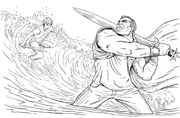 Ares fighting Percy Jackson. He tried to kill Percy with a giant boar, but Percy sliced off one of its tusks with Riptide and engulfed it with a wave, killing it instantly. He then challenged Ares to a duel - if Ares won, he would turn Percy into anything he wanted, and get the Master Bolt; if Percy won, then he got both the bolt and the helm and Ares had to leave. Eventually, Percy won the duel when he stabbed Ares in the heel; Ares tried to attack Percy again in a fit of rage, but Kronos prevented him. Before Ares departed, he warned Percy that he made a terrible mistake by making the God of War his enemy. He then curses Percy that his weapon would fail him when he needed it most, before leaving.When they get back to Olympus and explain who stole the items, Zeus says that "That is unlike Ares," while Poseidon disagrees and says it is "totally like him".
Later, while battling Chrysaor, Percy comments that he hadn't been challenged this much in a sword fight since his battle with Ares, as Chrysaor was just as good.
After Frank defeated all the Katoblepones in Venice, Mars comes to meet him. After a short period of time, Mars' form flickers and Ares comes. The god's form continues to flicker and Mars yells at Frank to go. Frank quickly changes his form and flies. When he looks back, a miniature mushroom cloud erupts and both the forms of the god yell "Noooo!". Ares and his Roman self were later heard fighting in Frank's head.
Ares was dominantly experienced and knowledgeable in all military tactics arts, making him a dangerous enemy to cross. However, because of his arrogant and brutal nature, Ares can be extremely reckless, overconfident, narcissistic and foolhardy, leading to him making crucial mistakes in a confrontation. He is supremely confident in his abilities, to the point of believing that he is invincible. This means that, despite being an excellent battle strategist and a fierce warrior, his reckless nature sets him apart from other Olympians like Athena, who is more calculative and precise in battle and does not make mistakes out of recklessness or overconfidence, her being the Goddess of Wisdom. Ares also appears to value physical strength in a fight, as opposed to astute strategy, and enjoys bloody wars - he saw that family feuds were the most vicious and therefore the most exciting.
Even when brainwashed by Kronos into starting a war among his family, Ares still thought it was amusing. He is a capable strategist, but his temper makes him tend to focus on brute strength and his arrogance leads him to underestimate his opponents, allowing clever fighters with less skill to get the better of him, his duel with Percy in The Lightning Thief being a notable example. Ares despises being called a coward and is willing to pick fights with people for no apparent reason. Ares believes that any problem can solve through fighting and encourages rebellion and violence above all else.
Despite his personality, Ares does have a soft spot for his lovers and his children even though he can be a strict parent, as shown with Clarisse. However, Ares is very protective of his children when they are in danger, as shown in Percy Jackson's Greek Gods when Ares violently kills Halirrhothius for trying to rape his daughter Alcippe. In addition, Ares was angered when Hephaestus imprisoned his mother Hera, and was the first to demand that the blacksmith god release her. Also, after greatly suffering in the Bronze Jar at the hands of Otis and Ephialtes, Ares gained a soft spot for prisoners of war, and would severely punish anyone who chose to treat them disrespectfully. Ares is also mentioned to have an extreme fear of jars, as a result of his ordeal.
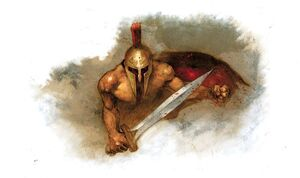 Ares in Percy Jackson's Greek Gods Ares is described as a huge, muscular man with a belligerent attitude and a vicious sneer. He typically wears black jeans, combat boots, a black leather duster, and a red muscle shirt under a bulletproof vest (his shield in disguise). He also has a large hunting knife strapped to his thigh. In the official artwork, he wears a necklace made from a heavy padlock and thick chain. He wears red-tinted wraparound sunglasses to cover his flame-filled eye sockets. His features are handsome, but in a cruel and brutal way, with knife-scarred cheeks and an "oily" black crew cut.To complete his thuggish biker guise, his spear and shield become an aluminum baseball bat and a bulletproof vest respectively. His war chariot also takes the shape of a black Harley Davidson motorcycle "the size of a baby elephant" with a flame pattern paint job on the gas tanks. The seat is apparently made from "Caucasian human skin", and loaded shotgun holsters are riveted to the motorcycle's sides. In its true form, Ares' chariot is red-and-gold (decorated with pictures of grizzly deaths in war), and pulled by four fierce, fire-breathing horses.
In Percy Jackson's Greek Gods, Ares wears Imperial Gold armor, that "burned with harsh light." According to Percy, when a bloodthirsty Ares rode into a battlefield wearing his golden war helmet, "he was too scary for most mortals to look at, much less fight." His golden shield is described as always smeared and dripping with blood and gore.
According to ReadRiordan, Ares usually wears his leather-clad biker unless he goes to war, where gleaming armor and a helmet that strikes fear in his enemies’ hearts.
Jump to navigation Jump to search This article is about the ancient Greek god. For other uses, see Ares (disambiguation). Not to be confused with Aries (astrology). AresAbodeSymbolsPersonal informationParentsSiblingsConsortChildrenRoman equivalentNorse equivalentHinduism equivalent
| War | |
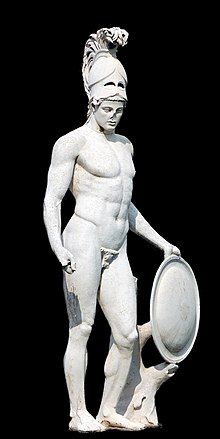 Statue of Ares from Hadrian's Villa Statue of Ares from Hadrian's Villa | |
| Mount Olympus, Thrace, Macedonia, Thebes, Sparta & Mani | |
| Sword, spear, shield, helmet, chariot, flaming torch, dog, boar, vulture | |
| Zeus and Hera | |
| Aeacus, Angelos, Aphrodite, Apollo, Artemis, Athena, Dionysus, Eileithyia, Enyo, Eris, Ersa, Hebe, Helen of Troy, Hephaestus, Heracles, Hermes, Minos, Pandia, Persephone, Perseus, Rhadamanthus, the Graces, the Horae, the Litae, the Muses, the Moirai | |
| Aphrodite and various others | |
| Erotes (Eros and Anteros), Phobos, Deimos, Phlegyas, Harmonia, Enyalios, Thrax, Oenomaus, and Amazons | |
| Mars | |
| Týr | |
| Kartikeya | |
| This article contains special characters. Without proper rendering support, you may see question marks, boxes, or other symbols. |
| Part of a series on |
 |
| Origins[show] |
| Sacred Places[show] |
| Deities[show] |
| Concepts[show] |
| Practices[show] |
| Hellenistic philosophy[show] |
| Philosophers[show] |
| Texts[show] |
| Other Topics[show] |
|
|
 Religion portal
 Ancient Greece portal
The Greeks were ambivalent toward Ares: although he embodied the physical valor necessary for success in war, he was a dangerous force, "overwhelming, insatiable in battle, destructive, and man-slaughtering."[3] His sons Phobos (Fear) and Deimos (Terror) and his lover, or sister, Enyo (Discord) accompanied him on his war chariot.[4] In the Iliad, his father Zeus tells him that he is the god most hateful to him.[5] An association with Ares endows places and objects with a savage, dangerous, or militarized quality.[6] His value as a war god is placed in doubt: during the Trojan War, Ares was on the losing side, while Athena, often depicted in Greek art as holding Nike (Victory) in her hand, favoured the triumphant Greeks.[3]
Ares plays a relatively limited role in Greek mythology as represented in literary narratives, though his numerous love affairs and abundant offspring are often alluded to.[7] When Ares does appear in myths, he typically faces humiliation.[8] He is well known as the lover of Aphrodite, the goddess of love, who was married to Hephaestus, god of craftsmanship.[9] The most famous story related to Ares and Aphrodite shows them exposed to ridicule through the wronged husband's device.[10]
The counterpart of Ares among the Roman gods is Mars,[11] who as a father of the Roman people was given a more important and dignified place in ancient Roman religion as a guardian deity. During the Hellenization of Latin literature, the myths of Ares were reinterpreted by Roman writers under the name of Mars. Greek writers under Roman rule also recorded cult practices and beliefs pertaining to Mars under the name of Ares. Thus in the classical tradition of later Western art and literature, the mythology of the two figures later became virtually indistinguishable.
Contents
- 1 Names
- 2 Character, origins, and worship
- 2.1 Ares in Sparta
- 2.2 Ares in the Arabian Peninsula
- 2.3 Ares in the Scythians
- 2.4 Ares in Ethiopia
- 3 Attributes
- 4 Cult and ritual
- 5 Attendants
- 6 Consorts and children
- 6.1 List of Ares's consorts and children
- 7 Hymns to Ares
- 8 Mythology
- 8.1 Founding of Thebes
- 8.2 Ares and Aphrodite
- 8.3 Ares and the giants
- 8.4 Iliad
- 9 Renaissance
- 10 In popular culture
- 11 See also
- 11.1 Friends and counselors
- 11.2 Attendants
- 11.3 Similar deities in non-Greek cultures
- 12 Notes and references
- 12.1 Notes
- 12.2 References
Names
The etymology of the name Ares is traditionally connected with the Greek word ἀρή (arē), the Ionic form of the Doric ἀρά (ara), "bane, ruin, curse, imprecation".[12] There may also be a connection with the Roman god of war, Mars, via hypothetical Proto-Indo-European *M̥rēs;[citation needed] compare Ancient Greek μάρναμαι (marnamai), "I fight, I battle".[13] Walter Burkert notes that "Ares is apparently an ancient abstract noun meaning throng of battle, war."[14] R. S. P. Beekes has suggested a Pre-Greek origin of the name.[15]
The earliest attested form of the name is the Mycenaean Greek 𐀀𐀩, a-re, written in the Linear B syllabic script.[16][17][18]
The adjectival epithet, Areios, was frequently appended to the names of other gods when they took on a warrior aspect or became involved in warfare: Zeus Areios, Athena Areia, even Aphrodite Areia. In the Iliad, the word ares is used as a common noun synonymous with "battle."[3]
Inscriptions as early as Mycenaean times, and continuing into the Classical period, attest to Enyalios as another name for the god of war.[n 1]
Character, origins, and worship
Vatican, Rome, Italy. Statue of Ares, Scopas's influence. Brooklyn Museum Archives, Goodyear Archival Collection
Ares was one of the Twelve Olympians in the archaic tradition represented by the Iliad and Odyssey. Zeus expresses a recurring Greek revulsion toward the god when Ares returns wounded and complaining from the battlefield at Troy:
Then looking at him darkly Zeus who gathers the clouds spoke to him:
"Do not sit beside me and whine, you double-faced liar.
To me you are the most hateful of all gods who hold Olympus.
Forever quarrelling is dear to your heart, wars and battles.
...
And yet I will not long endure to see you in pain, since
you are my child, and it was to me that your mother bore you.
But were you born of some other god and proved so ruinous
long since you would have been dropped beneath the gods of the bright sky."[21]
This ambivalence is expressed also in the Greeks' association of Ares with the Thracians, whom they regarded as a barbarous and warlike people.[22] Thrace was Ares's birthplace, his true home, and his refuge after the affair with Aphrodite was exposed to the general mockery of the other gods.[n 2]
A late-6th-century BC funerary inscription from Attica emphasizes the consequences of coming under Ares's sway:
Stay and mourn at the tomb of dead Kroisos
Whom raging Ares destroyed one day, fighting in the foremost ranks.[23]
Ares in Sparta
In Sparta, Ares was viewed as a model soldier: his resilience, physical strength, and military intelligence were unrivaled. An ancient statue, representing the god in chains, suggests that the martial spirit and victory were to be kept in the city of Sparta. That the Spartans admired him is indicative of the cultural divisions that existed between themselves and other Greeks, especially the Athenians (see Pelopponesian War).
Ares in the Arabian Peninsula
Ares was also worshipped by the inhabitants of Tylos. It is not known if he was worshipped in the form of an Arabian god (or which one) or if he was worshipped in his Greek form.[24]
Ares in the Scythians
According to Herodotus' Histories, the Scythians worshipped a god he equated with the Greek Ares; unlike most other Scythian gods, he does not offer the indigenous name for this deity. While ranking beneath Tabiti, Api and Papaios in the divine hierarchy, this god was apparently worshipped differently from other Scythian gods, with statues and complex altars devoted to him. This type of worship is noted to be present among the Alans.[25]
Noting how Greek mythological Amazons are devotees of Ares and most likely based on Scythian warriors, some researchers have considered the possibility that a Scythian warrior women cult of this deity existed.[26] Others have also posited that the "Sword of Mars" alludes to the Huns having adopted this deity.[27]
Ares in Ethiopia
Maḥrem, the principal god of the kings of Aksum prior to the 4th century AD, was always equated with Ares. In their Greek inscriptions, the kings invoke Ares. In bilingual inscriptions, where the Ethiopic has Maḥrem the Greek will have Ares. The anonymous king who put up the Monumentum Adulitanum in the late 2nd or early 3rd century refers to "my greatest god, Ares, who also begat me, through whom I brought under my sway" various peoples. The monumental throne celebrating the king's conquests was itself dedicated to Ares.[28] In the early 4th century, the last pagan king of Aksum, Ezana, referred to "the one who brought me forth, the invincible Ares".[29]
Attributes
The Ares Borghese.
Ares’ attributes were a helmet, shield, and sword or spear.[30] The birds of Ares (Ornithes Areioi) were a flock of feather-dart-dropping birds that guarded the Amazons' shrine of the god on a coastal island in the Black Sea.[31]
Cult and ritual
Although Ares received occasional sacrifice from armies going to war, the god had a formal temple and cult at only a few sites.[32] At Sparta, however, each company of youths sacrificed a puppy to Enyalios before engaging in ritual fighting at the Phoebaeum.[n 3] The chthonic night-time sacrifice of a dog to Enyalios became assimilated to the cult of Ares.[34]
Just east of Sparta stood an archaic statue of Ares in chains, to show that the spirit of war and victory was to be kept in the city.[n 4]
The Temple of Ares in the agora of Athens, which Pausanias saw in the second century AD, had been moved and rededicated there during the time of Augustus. Essentially, it was a Roman temple to the Augustan Mars Ultor.[32] From archaic times, the Areopagus, the "mount of Ares" at some distance from the Acropolis, was a site of trials. Paul the Apostle later preached about Christianity there. Its connection with Ares, perhaps based on a false etymology, is etiological myth.[citation needed] A second temple to Ares has been located at the archaeological site of Metropolis in what is now Western Turkey.[36]
AND NOW SOME INFORMATIONS ABOUT ARES ACCORDING TO PERCY JACKSON AND THE BOOKS OF RICK RIORDAN...
| Ares | Mars |
Ares
| “ | That means I can smash him into a pulp as often as I want, and he'll just keep coming back for more. I like this idea. | ” |
| –Ares, commenting on Percy's offer of immortality, The Last Olympian. | ||
History
Ares is one of the few children of the Olympian gods Zeus and Hera. He developed a love of violence that surpassed that of any other Olympian, which made him the perfect candidate for being the god of war. It also made him unpopular among his fellow deities who despised him for his overt love of war regardless of there not being a reason to fight at all. Despite this, he was given a place on the Olympian ruling council possibly due to his parentage. Aphrodite, his lover As the god of war, Ares would often participate in mortal conflicts, but would often fare poorly in divine contests. He would lend strength to whatever side he favored, but was known to be somewhat fickle and change sides in the middle of a battle. The blessing of Ares is known to give invincibility in battle. Despite his great strength and fighting ability Ares often fared poorly in battles with other supernatural enemies. His half-brother Hercules is noted to have stalemated him in battle twice. At one point he stripped Ares of his armor and another time defeated Ares and one of his children with the aid of Athena. The Alodai giants (Otis and Ephialtes) defeated Ares and imprisoned him within an airtight bronze jar. During the Trojan War Ares sided with the Trojans despite promising Hera he would aid the Greeks. For his actions, he was wounded by the mortal hero Diomedes with the aid of Athena. After Zeus allowed the Olympians to participate openly in the war he challenged Athena, only to again be defeated by her, and forced to flee the battlefield. Apollo also defeated him in a boxing match during the first Olympic games. Ares also fled in fear of the giant Typhon when the monster first attacked Olympus, though most other Olympians (other than Zeus) did as well. Even though Ares was the god of war, some say he disturbed the gods with his loud bellows when he lost. Despite these setbacks, Ares fought bravely in the Gigantomachy and defended Olympus successfully against several other enemies.Olympian Murder Trial
After Halirrhothius (Poseidon's son) attempted to rape Ares' daughter Alcippe, she summoned her father for help. The infuriated god of war quickly arrived, and brutally slew Halirrhothius. An outraged Poseidon demanded that Ares be put on trial for the murder of his son, to which Zeus agreed. The first ever Olympian murder trial took place on the Areopagus Hill in Athens. Zeus, as the god of honor and justice, was the Chief Justice, while the other ten Olympians served as members of the jury. In the end, Zeus justly acquitted Ares, since the latter was defending his daughter's honor.Relationship with Aphrodite
To Ares' outrage, Zeus had paired his other son, Hephaestus, up with the beautiful goddess Aphrodite to be married. Aphrodite was miserable with her marriage. Because of that Ares and Aphrodite began to have several love affairs. Ares and Aphrodite would frequently meet up and do whatever they pleased. Hephaestus discovered his wife's promiscuity through Helios, the all-seeing Titan of Sun . One day when they were laying together in bed, Hephaestus planted an unbreakable golden chain-link net so small to be invisible that they got tangled up in. Hephaestus called all of the Olympians to so that they could mock and shame them. He first called Hermes , and asked humble to send the message to all the gods. However, Zeus and Hermes found the situation hilarious, and were promptly joined in prolonged contagious laughter by the other gods, with Apollo jeering at Ares and Athena at Aphrodite. In the end, however, Poseidon convinced Hephaestus that if he let them go, Ares would have to pay an adulterer's fine for his offense.Sisyphus
King Sisyphus of Corinth, not wanting to die, managed to cheat death by immobilizing Thanatos with heavy chains and placing the latter under his royal bed. As a result, with Death itself imprisoned, mortals were unable to die, much to the dismay of Ares, who relished military carnage. As a result, the war god promptly found Thanatos and freed him, after which both gods incinerated Sisyphus.Percy Jackson and the Olympians
The Lightning Thief
During the Winter solstice, Luke Castellan stole the Master Bolt and the Helm of Darkness. Ares caught him, but Luke convinced him into carrying out Kronos' plan. Ares lets Luke go and kept the Helm and the Bolt until Percy came along to complete the delivery. On June 14, seven days before the Summer Solstice deadline, Ares approached Percy Jackson, Grover Underwood, and Annabeth Chase on his motorcycle as they were trying to get dinner. He "generously" paid for their meal (frightening many of the customers and staff in the process) and then got the companions to retrieve his shield (in the form of a bulletproof vest) from the Tunnel of Love ride in an abandoned Waterland. In return, he told them to jump in an animal smugglers truck to get to Los Angeles.At this point, he also gave Percy a backpack with $20, a pouch of golden drachmas, fresh clothes for the three of them, and a box of Double-Stuffed Oreos. However, this backpack was actually the modified sheath for the master lightning bolt, enchanted by Ares to have the Master Bolt appear in it when Percy got close to Hades. After Percy, Grover, and Annabeth escaped from the Underworld by using the pearls given to Percy by the Nereid, Ares was waiting to kill them at the beach.
Ares revealed the reasoning behind his plan; Poseidon would declare war on Hades for killing Percy, Zeus would declare war on Hades for having the Master Bolt, and Hades would attack both of them, as he thinks one of them has his Helm of Darkness. He then remarks that a war between his relatives is the best kind of war when Annabeth protests 'But they're your family!' He then accidentally revealed that Kronos was controlling him through his dreams.
Ares fighting Percy Jackson. He tried to kill Percy with a giant boar, but Percy sliced off one of its tusks with Riptide and engulfed it with a wave, killing it instantly. He then challenged Ares to a duel - if Ares won, he would turn Percy into anything he wanted, and get the Master Bolt; if Percy won, then he got both the bolt and the helm and Ares had to leave. Eventually, Percy won the duel when he stabbed Ares in the heel; Ares tried to attack Percy again in a fit of rage, but Kronos prevented him. Before Ares departed, he warned Percy that he made a terrible mistake by making the God of War his enemy. He then curses Percy that his weapon would fail him when he needed it most, before leaving.When they get back to Olympus and explain who stole the items, Zeus says that "That is unlike Ares," while Poseidon disagrees and says it is "totally like him".The Sea of Monsters
Ares is seen talking to his daughter Clarisse La Rue on the ironclad CSS Birmingham. He orders his daughter not to fail the quest (and threatens her to make her do it), and get Percy Jackson and his friends out of the way and to make him proud. For this reason, Clarisse refuses to let Percy, Annabeth, and Tyson go, but they all escape when the ironclad explodes.The Titan's Curse
Ares appears Junkyard of the Gods, bringing a white limousine with the goddess Aphrodite inside. He is last seen in the Winter solstice where he voted "Yes" on the destruction of Percy Jackson, along with Dionysus and Athena. In addition, the curse he gave to Percy (that, at a crucial time, his sword would fail him) comes back to haunt, when Percy fights Atlas, his sword becomes too heavy to lift.The Last Olympian
Ares is only seen attacking Typhon with a knife while riding his motorcycle, and to congratulate his daughter Clarisse on defeating the drakon and called her "the greatest warrior I have ever seen." He later voted for Percy becoming immortal, muttering "I like this idea, then I get to smash him to a pulp and he'll keep coming back for more," when the gods give Percy Jackson the chance of becoming a god. That is probably because he can keep on fighting Percy without him dying.The Heroes of Olympus
The Son of Neptune
Ares appears as Mars at Camp Jupiter proclaiming that there is a quest that should be taken. Percy is rude to him and notes that he believes that they have fought. Mars then explains that if he had fought him it was probably in his Greek form because he has no memory of fighting him, though it may be a lie.The Mark of Athena
Ares, along with most of the other Olympians, was incapacitated (with his personality split between him and his Roman form) after Leo Valdez was manipulated by Gaea into shooting upon Camp Jupiter from the Argo II. As a result, Frank Zhang is plagued with voices of the two aspects of his father, Mars, and Ares. The latter repeatedly urges Frank to take vengeance against Leo every time he made fun of him. This was why, during this time, Frank seemed so clumsy, irascible, and slow.Later, while battling Chrysaor, Percy comments that he hadn't been challenged this much in a sword fight since his battle with Ares, as Chrysaor was just as good.
The House of Hades
It is revealed that as soon as the fighting had broke out in Camp Jupiter, the war gods two forms voices would continuously yell in Frank's head. Ares and Mars would continuously yell at each other and only agreed on few things like - kill Leo for joking about Frank, kill Triptolemus and they would give the power of turning enemies into snakes to Horatius.After Frank defeated all the Katoblepones in Venice, Mars comes to meet him. After a short period of time, Mars' form flickers and Ares comes. The god's form continues to flicker and Mars yells at Frank to go. Frank quickly changes his form and flies. When he looks back, a miniature mushroom cloud erupts and both the forms of the god yell "Noooo!". Ares and his Roman self were later heard fighting in Frank's head.
The Blood of Olympus
When Reyna Ramírez-Arellano, with the help of six pegasi finally manages to place the Athena Parthenos on Half-Blood Hill, golden light ripples across the ground, seeping warmth into the bones of both Greek and Roman demigods, and curing all of the Olympians (including Ares) of their split personalities. As a result, Ares promptly arrives in Athens to participate in the final battle with the Giants. He fights side by side with his son Frank, both of them managing to smash through an entire phalanx of Giants, with the god of war disemboweling his opponents with his sword "as easily as a child destroying piñatas." After each Giants is killed, Hades promptly sends their body back to Tartarus by opening up abysses under them. After the battle, Ares enthusiastically compliments Frank on his fighting ability, and seems to enjoy the victory more than most of his fellow Olympians. He proceeds to watch as Zeus hurls the Argo II all the way back to Camp Half-Blood.Personality
Ares is aloof, cruel, impetuous, proud, and violent; an easily angered bully who seems to care only about fighting and killing. He is also very sadistic, roaring with laughter whilst fighting Percy and blowing up mortal cops during their duel in The Lightning Thief. Because of this, he is disliked by many gods and mortals. However, Ares does have a loving relationship with Aphrodite, and is good friends with Thanatos, since the god of war does not enjoy bloodshed without Death, and personally freed him after Sisyphus chained Thanatos up. Also, despite their occasional quarrels, Ares was usually on good terms with Poseidon, who spoke up for Ares when the latter was imprisoned and humiliated by Hephaestus.Ares was dominantly experienced and knowledgeable in all military tactics arts, making him a dangerous enemy to cross. However, because of his arrogant and brutal nature, Ares can be extremely reckless, overconfident, narcissistic and foolhardy, leading to him making crucial mistakes in a confrontation. He is supremely confident in his abilities, to the point of believing that he is invincible. This means that, despite being an excellent battle strategist and a fierce warrior, his reckless nature sets him apart from other Olympians like Athena, who is more calculative and precise in battle and does not make mistakes out of recklessness or overconfidence, her being the Goddess of Wisdom. Ares also appears to value physical strength in a fight, as opposed to astute strategy, and enjoys bloody wars - he saw that family feuds were the most vicious and therefore the most exciting.
Even when brainwashed by Kronos into starting a war among his family, Ares still thought it was amusing. He is a capable strategist, but his temper makes him tend to focus on brute strength and his arrogance leads him to underestimate his opponents, allowing clever fighters with less skill to get the better of him, his duel with Percy in The Lightning Thief being a notable example. Ares despises being called a coward and is willing to pick fights with people for no apparent reason. Ares believes that any problem can solve through fighting and encourages rebellion and violence above all else.
Despite his personality, Ares does have a soft spot for his lovers and his children even though he can be a strict parent, as shown with Clarisse. However, Ares is very protective of his children when they are in danger, as shown in Percy Jackson's Greek Gods when Ares violently kills Halirrhothius for trying to rape his daughter Alcippe. In addition, Ares was angered when Hephaestus imprisoned his mother Hera, and was the first to demand that the blacksmith god release her. Also, after greatly suffering in the Bronze Jar at the hands of Otis and Ephialtes, Ares gained a soft spot for prisoners of war, and would severely punish anyone who chose to treat them disrespectfully. Ares is also mentioned to have an extreme fear of jars, as a result of his ordeal.
Appearance
Ares in Percy Jackson's Greek Gods Ares is described as a huge, muscular man with a belligerent attitude and a vicious sneer. He typically wears black jeans, combat boots, a black leather duster, and a red muscle shirt under a bulletproof vest (his shield in disguise). He also has a large hunting knife strapped to his thigh. In the official artwork, he wears a necklace made from a heavy padlock and thick chain. He wears red-tinted wraparound sunglasses to cover his flame-filled eye sockets. His features are handsome, but in a cruel and brutal way, with knife-scarred cheeks and an "oily" black crew cut.To complete his thuggish biker guise, his spear and shield become an aluminum baseball bat and a bulletproof vest respectively. His war chariot also takes the shape of a black Harley Davidson motorcycle "the size of a baby elephant" with a flame pattern paint job on the gas tanks. The seat is apparently made from "Caucasian human skin", and loaded shotgun holsters are riveted to the motorcycle's sides. In its true form, Ares' chariot is red-and-gold (decorated with pictures of grizzly deaths in war), and pulled by four fierce, fire-breathing horses.In Percy Jackson's Greek Gods, Ares wears Imperial Gold armor, that "burned with harsh light." According to Percy, when a bloodthirsty Ares rode into a battlefield wearing his golden war helmet, "he was too scary for most mortals to look at, much less fight." His golden shield is described as always smeared and dripping with blood and gore.
According to ReadRiordan, Ares usually wears his leather-clad biker unless he goes to war, where gleaming armor and a helmet that strikes fear in his enemies’ hearts.
HERMES THE GOD OF ALL
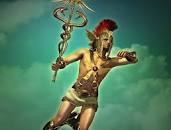
HERMES
Hermes was the ancient Greek god of trade, wealth, luck, fertility, animal husbandry, sleep, language, thieves, and travel. One of the cleverest and most mischievous of the Olympian gods, he was the patron of shepherds, invented the lyre, and was, above all, the herald and messenger of Mt. Olympus so that he came to symbolise the crossing of boundaries in his role as a guide between the two realms of gods and humanity. To the Romans, the god was known as Mercury.
Origins & Family
Hermes has a very long history, being mentioned in the Linear B tablets of the Mycenaean civilization, at its height from the 15th to 13th century BCE. Such tablets have been discovered at Pylos, Thebes, and Knossos. With origins, then, as an Arcadian fertility god who had a special love for the Peloponnese, the ancient Greeks believed Hermes was the son of Zeus and the nymph Maia (daughter of the Titan Atlas) and that he was born on Mt. Cyllene in Arcadia. In mythology, Hermes was also the father of the pastoral god Pan and Eudoros (with Polymele), one of the leaders of the Myrmidons, although the god was not given a wife in any Greek myth. The idea that Hermes represented movement is reflected in his role as the leader of both the Nymphs and Graces (Charites).
Hermes was known as something of a trickster, stealing at one time or another Poseidon’s trident, Artemis’ arrows & Aphrodite’s girdle. Hermes & the Gods
Noted for his impish character and constant search for amusement, Hermes was one of the more colourful gods in Greek mythology. While still a baby, he stole his half-brother Apollo’s sacred herd of 50 cattle from Pieria, cleverly reversing their hoofmarks by adding bark shoes to make it difficult to follow their tracks. Hermes, therefore, became associated with thieves and he managed to keep the stolen herd until the satyrs finally discovered it in a cave in Arcadia. After a hearing before Zeus and the Olympian gods, Hermes was permitted to hold on to the herd (now down to 48 as he had already sacrificed two of them) if he gave Apollo his lyre. The episode illustrates the god’s link with both physical and moral boundaries and crossing them, and may have a basis in historical events, as here described by the famed expert on Greek mythology Robert Graves:
A tradition of cattle raids made by the crafty Messenians on their neighbours, and of a treaty by which these were discontinued, seems to have been mythologically combined with an account of how the barbarous Hellenes took over and exploited, in the name of their adopted god Apollo, the Creto-Helladic civilizations which they found in Central and Southern Greece. (66)
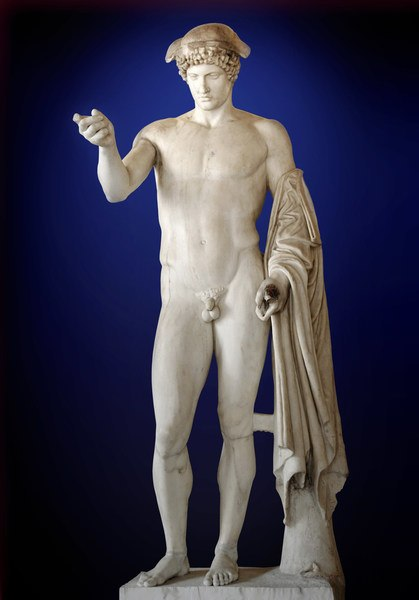 Hermes Ludovesiby Marie-Lan Nguyen (CC BY-SA) As messenger and herald, particularly for Zeus, Hermes is involved in many mythological episodes. Perhaps most celebrated was his killing of the many-eyed (some accounts say 100-eyed) monster Argos on the orders of Zeus in order to free Io. Hermes also freed Ares from his year-long imprisonment in a cauldron by the twin Giants Otus and Ephialtes. One of his most famous regular roles was as a leader of souls to the river Styx in the underworld, where the boatman Charon would take them to Hades. Hermes was also known as something of a trickster, stealing at one time or another Poseidon’s trident, Artemis’ arrows, and Aphrodite’s girdle.Famous for his diplomatic skills, Hermes was regarded as the patron of languages & rhetoric. Hermes & the HeroesHermes figures in the Trojan War as told by Homer in the Iliad. Although in one lengthy passage he acts as counsellor and guide to the Trojan King Priam in his attempt to reclaim the body of his fallen son Hector, Hermes actually supports the Achaeans in the Trojan War. The god is most often described by Homer as ‘Hermes the guide, slayer of Argos’ and ‘Hermes the kindly’. Hermes gives particular help to Odysseus, especially on his long return voyage to Ithaca (as told in Homer’s Odyssey), for example, giving him an antidote to the spells of Circe. Another hero helped by the god was Perseus, Hermes giving him an unbreakable sword or sickle (harpe) of adamantine and guiding him to the three Graeae who would reveal the location of Medusa.
Inventions & Associations
Hermes was credited with inventing fire, the alphabet, dice (actually knucklebones) - and so he was worshipped by gamblers in his capacity as god of luck and wealth, and musical instruments, in particular, the lyre - made from a tortoiseshell by the god. Hermes was regarded as the patron of shepherds thanks to his invention of the pan pipes (syrinx). Travellers regarded him as their patron, and stone pillars (hermae) with a phallus symbol were often to be seen set up along roadsides to act as guides and offer good fortune to those who passed. Hermae were particularly set up at boundaries, reminding of the god’s role as a messenger between the gods and humanity, as well as his function as a guide for the dead into the next life. In addition, Hermes was regarded as the patron of the home, and people often built small marble stelai in front of their doors in his honour.
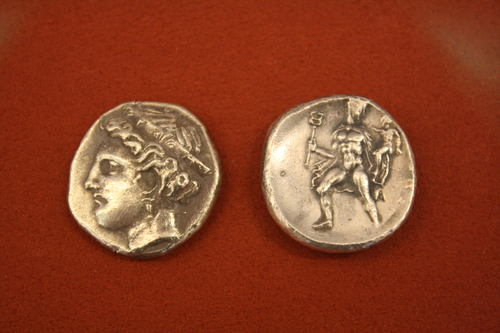 Pheneos Silver Staterby Mark Cartwright (Copyright) Famous for his diplomatic skills, he was also regarded as the patron of languages and rhetoric. Orators regarded the god who transferred words from sender to receiver as their patron, as did interpreters (another group of boundary-crossers) and, even today, the study and interpretation of texts carries his name: hermeneutics. In the Hellenistic period, the god was often associated with gymnasia and seen as the protector of youths. Finally, the god’s Latin name, Mercury, is, of course, the name of a planet, naturally, the fastest one to orbit the sun.Cults to the GodHermes was honoured just about everywhere in the Greek world but especially in the Peloponnese at Mt. Cyllene and such city-states as Megalopolis, Corinth and Argos. Athens had one of the oldest cults to the god where the Hermaia festival for young boys was held annually. Delos, Tanagra, and the Cyclades were other places where Hermes was especially popular. Finally, the god had a noted sanctuary on Crete at Kato Symi where young men about to become full citizens engaged in a two-month-long rite where they spent time cultivating homosexual relations with older men in the mountains thereabouts. Another Hermaia festival on Crete permitted slaves to temporarily take the part of their masters. Once again, Hermes’ association with crossing boundaries of all kinds is evident here.
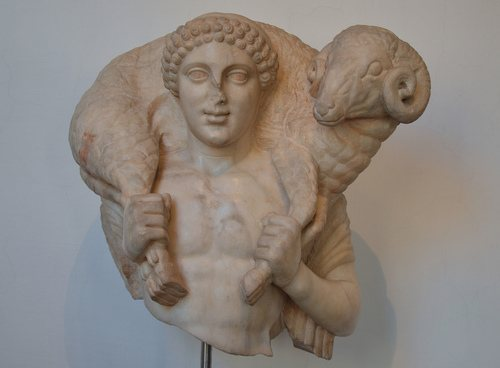 Hermes Kriophorosby Carole Raddato (CC BY-NC-SA) Representation in ArtIn ancient Greek Archaic and Classical art, Hermes is depicted holding the kerykeion or caduceus staff (signifying his role as a herald, the stick is either cleft or with an open figure of 8 at the top), wearing winged sandals (symbolic of his role as a messenger), a long tunic or leopard skin, sometimes also a winged cap (petasos), and occasionally with a lyre. He may also carry a ram in a nod to his role as patron of shepherds, especially in Boeotian and Arcadian art. In his association with youths, the god was often portrayed holding the infant Hercules or Achilles. At the same time, his association with trade is evidenced in the seals of Delos where he carries a purse. Perhaps the most celebrated depiction of Hermes in Greek art is the magnificent statue by Praxiteles (c. 330 BCE) which once stood in the temple of Hera at Olympia and now resides in the archaeological museum of the site.
Hermes was the ancient Greek god of trade, wealth, luck, fertility, animal husbandry, sleep, language, thieves, and travel. One of the cleverest and most mischievous of the Olympian gods, he was the patron of shepherds, invented the lyre, and was, above all, the herald and messenger of Mt. Olympus so that he came to symbolise the crossing of boundaries in his role as a guide between the two realms of gods and humanity. To the Romans, the god was known as Mercury.
Origins & Family
Hermes has a very long history, being mentioned in the Linear B tablets of the Mycenaean civilization, at its height from the 15th to 13th century BCE. Such tablets have been discovered at Pylos, Thebes, and Knossos. With origins, then, as an Arcadian fertility god who had a special love for the Peloponnese, the ancient Greeks believed Hermes was the son of Zeus and the nymph Maia (daughter of the Titan Atlas) and that he was born on Mt. Cyllene in Arcadia. In mythology, Hermes was also the father of the pastoral god Pan and Eudoros (with Polymele), one of the leaders of the Myrmidons, although the god was not given a wife in any Greek myth. The idea that Hermes represented movement is reflected in his role as the leader of both the Nymphs and Graces (Charites).
Hermes was known as something of a trickster, stealing at one time or another Poseidon’s trident, Artemis’ arrows & Aphrodite’s girdle. Hermes & the Gods
Noted for his impish character and constant search for amusement, Hermes was one of the more colourful gods in Greek mythology. While still a baby, he stole his half-brother Apollo’s sacred herd of 50 cattle from Pieria, cleverly reversing their hoofmarks by adding bark shoes to make it difficult to follow their tracks. Hermes, therefore, became associated with thieves and he managed to keep the stolen herd until the satyrs finally discovered it in a cave in Arcadia. After a hearing before Zeus and the Olympian gods, Hermes was permitted to hold on to the herd (now down to 48 as he had already sacrificed two of them) if he gave Apollo his lyre. The episode illustrates the god’s link with both physical and moral boundaries and crossing them, and may have a basis in historical events, as here described by the famed expert on Greek mythology Robert Graves:
A tradition of cattle raids made by the crafty Messenians on their neighbours, and of a treaty by which these were discontinued, seems to have been mythologically combined with an account of how the barbarous Hellenes took over and exploited, in the name of their adopted god Apollo, the Creto-Helladic civilizations which they found in Central and Southern Greece. (66)
Hermes Ludovesiby Marie-Lan Nguyen (CC BY-SA) As messenger and herald, particularly for Zeus, Hermes is involved in many mythological episodes. Perhaps most celebrated was his killing of the many-eyed (some accounts say 100-eyed) monster Argos on the orders of Zeus in order to free Io. Hermes also freed Ares from his year-long imprisonment in a cauldron by the twin Giants Otus and Ephialtes. One of his most famous regular roles was as a leader of souls to the river Styx in the underworld, where the boatman Charon would take them to Hades. Hermes was also known as something of a trickster, stealing at one time or another Poseidon’s trident, Artemis’ arrows, and Aphrodite’s girdle.Famous for his diplomatic skills, Hermes was regarded as the patron of languages & rhetoric. Hermes & the HeroesHermes figures in the Trojan War as told by Homer in the Iliad. Although in one lengthy passage he acts as counsellor and guide to the Trojan King Priam in his attempt to reclaim the body of his fallen son Hector, Hermes actually supports the Achaeans in the Trojan War. The god is most often described by Homer as ‘Hermes the guide, slayer of Argos’ and ‘Hermes the kindly’. Hermes gives particular help to Odysseus, especially on his long return voyage to Ithaca (as told in Homer’s Odyssey), for example, giving him an antidote to the spells of Circe. Another hero helped by the god was Perseus, Hermes giving him an unbreakable sword or sickle (harpe) of adamantine and guiding him to the three Graeae who would reveal the location of Medusa.Inventions & Associations
Hermes was credited with inventing fire, the alphabet, dice (actually knucklebones) - and so he was worshipped by gamblers in his capacity as god of luck and wealth, and musical instruments, in particular, the lyre - made from a tortoiseshell by the god. Hermes was regarded as the patron of shepherds thanks to his invention of the pan pipes (syrinx). Travellers regarded him as their patron, and stone pillars (hermae) with a phallus symbol were often to be seen set up along roadsides to act as guides and offer good fortune to those who passed. Hermae were particularly set up at boundaries, reminding of the god’s role as a messenger between the gods and humanity, as well as his function as a guide for the dead into the next life. In addition, Hermes was regarded as the patron of the home, and people often built small marble stelai in front of their doors in his honour.
Pheneos Silver Staterby Mark Cartwright (Copyright) Famous for his diplomatic skills, he was also regarded as the patron of languages and rhetoric. Orators regarded the god who transferred words from sender to receiver as their patron, as did interpreters (another group of boundary-crossers) and, even today, the study and interpretation of texts carries his name: hermeneutics. In the Hellenistic period, the god was often associated with gymnasia and seen as the protector of youths. Finally, the god’s Latin name, Mercury, is, of course, the name of a planet, naturally, the fastest one to orbit the sun.Cults to the GodHermes was honoured just about everywhere in the Greek world but especially in the Peloponnese at Mt. Cyllene and such city-states as Megalopolis, Corinth and Argos. Athens had one of the oldest cults to the god where the Hermaia festival for young boys was held annually. Delos, Tanagra, and the Cyclades were other places where Hermes was especially popular. Finally, the god had a noted sanctuary on Crete at Kato Symi where young men about to become full citizens engaged in a two-month-long rite where they spent time cultivating homosexual relations with older men in the mountains thereabouts. Another Hermaia festival on Crete permitted slaves to temporarily take the part of their masters. Once again, Hermes’ association with crossing boundaries of all kinds is evident here. Hermes Kriophorosby Carole Raddato (CC BY-NC-SA) Representation in ArtIn ancient Greek Archaic and Classical art, Hermes is depicted holding the kerykeion or caduceus staff (signifying his role as a herald, the stick is either cleft or with an open figure of 8 at the top), wearing winged sandals (symbolic of his role as a messenger), a long tunic or leopard skin, sometimes also a winged cap (petasos), and occasionally with a lyre. He may also carry a ram in a nod to his role as patron of shepherds, especially in Boeotian and Arcadian art. In his association with youths, the god was often portrayed holding the infant Hercules or Achilles. At the same time, his association with trade is evidenced in the seals of Delos where he carries a purse. Perhaps the most celebrated depiction of Hermes in Greek art is the magnificent statue by Praxiteles (c. 330 BCE) which once stood in the temple of Hera at Olympia and now resides in the archaeological museum of the site. THE LIFE OF HERCULES IN MYTH AND LEGEND
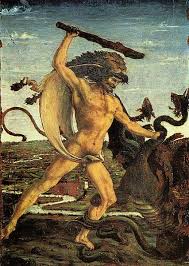
- The Life of Hercules in Myth & Legend
Hercules is the Roman name for the Greek hero Herakles, the most popular figure from ancient Greek mythology. Hercules was the son of Zeus, king of the gods, and the mortal woman Alcmene. Zeus, who was always chasing one woman or another, took on the form of Alcmene's husband, Amphitryon, and visited Alcmene one night in her bed, and so Hercules was born a demi-god with incredible strength and stamina. He performed amazing feats, including wrestling death and traveling twice to the underworld, and his stories were told throughout Greece and later in Rome, yet his life was far from easy from the moment of his birth, and his relationships with others were often disastrous. This was because Hera, the wife of Zeus, knew that Hercules was her husband's illegitimate son and sought to destroy him. In fact, he was born with the name Alcaeus and later took the name Herakles, meaning "Glory of Hera", signifying that he would become famous through his difficulties with the goddess.
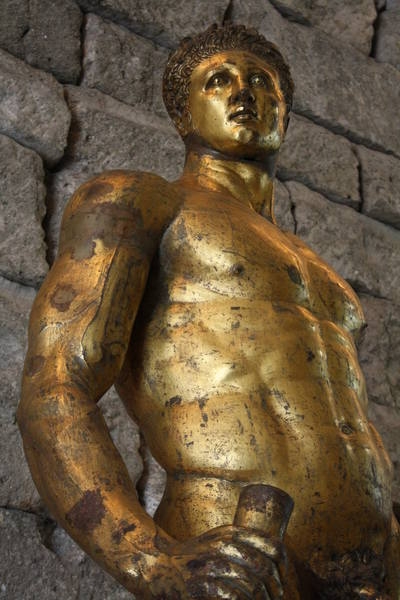 Gilded Bronze Herculesby Mark Cartwright (CC BY-NC-SA) The demi-god, who suffered like mortals and who could make a mess of things in life just as easily as any man or woman but perform deeds no mortal could, had great appeal for the people of Greece and Rome. Hercules was a kind of super-powered everyman who suffered disappointments, had bad days - even bad years - and eventually died due to another's trickery. These stories, besides simply being entertaining, would have served an ancient audience by letting them know that, if bad things could happen to a hero like Hercules, they had nothing to complain about regarding the disappointments and tragedies in their own lives. Hercules served as a symbol of the human condition where, to use Hemingway's phrase, "a man may be destroyed, but not defeated." An interesting aspect of Hercules' character is that, because of his divine strength and abilities, he did not have to willingly submit to any of the labors or punishments imposed upon him. He chose to suffer indignities such as his famous Twelve Labors or his servitude to the queen Omphale and did so willingly. His inner strength and ability to endure hardships made him an inspirational figure to the people and a symbol of stability in the midst of chaos, even if it was a chaos he himself had caused. The historian Thomas R. Martin writes:The only hero to whom cults were established internationally, all over the Greek world, was the strongman Herakles (Hercules). His superhuman feats in overcoming monsters and generally doing the impossible gave him an appeal as a protector in many city-states (129).
Early Life
Although he was seen as the champion of the weak and a great protector, Hercules' personal problems started literally at birth. Hera sent two witches to prevent the birth, but they were tricked by one of Alcmene's servants and sent to another room. Hera then sent serpents to kill him in his cradle, but Hercules strangled them both. In one version of the myth, Alcmene abandoned her baby in the woods in order to protect him from Hera's wrath, but he was found by the goddess Athena who brought him to Hera, claiming he was an orphan child left in the woods who needed nourishment. Hera suckled Hercules at her own breast until the infant bit her nipple, at which point she pushed him away, spilling her milk across the night sky and so forming the Milky Way. She then gave the infant back to Athena and told her to take care of the baby herself. In feeding the child from her own breast, the goddess inadvertently imbued him with further strength and power.
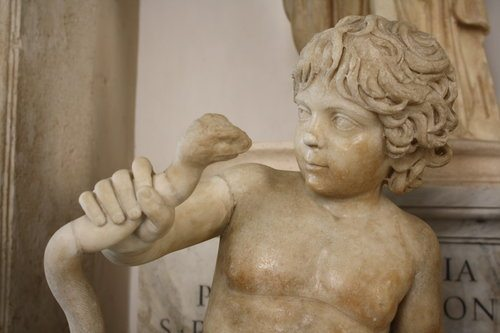 The Infant Herculesby Mark Cartwright (CC BY-NC-SA) He was brought up at the court of his supposed-father Amphitryon, where he had the best tutors in the land who taught him wrestling, horseback riding, fencing, archery, how to drive a chariot, play the lyre, and sing. Hercules did not know his own strength, however, and killed his music teacher, Linus, by hitting him with a lyre one day during an argument. He was then sent to tend the flocks to keep him out of trouble. This seems to have been an impossibility for Hercules, however, as he heard that the Theban army had been defeated by a band of Minyans and, feeling this was unjust, he led a band of Theban warriors to defeat the Minyans and restore order to Thebes. King Creon of Thebes gave Hercules his daughter, Megara, in marriage as a sign of his gratitude. The Madness of Hera & the Twelve Labors At this point in the story, Hercules was a young, successful hero, married and, in time, with three strong sons. Hera could not tolerate the situation and so sent upon him a madness in which he killed his children (and, in some versions, Megara as well). He continued in his rage until Athena knocked him out with a stone and, when he came to, he was overwhelmed with grief at what he had done. He would have killed himself but his cousin Theseus convinced him that would be cowardly and that he must find a way to atone for his sins. Hercules consulted the Oracle at Delphi who told him he must attach himself to his cousin Eurystheus, King of Tiryns and Mycenae, who would devise labors to expiate his sins. These labors originally numbered only ten but later grew to twelve. After Delphi he was no longer known as Alcaeus and took the name Herakles.
The Twelve Labors of Hercules were:
1. To kill the Nemean Lion who was impervious to all weapons. He trapped the lion in a cave and strangled it with his bare hands. He then skinned it and ever after wore the skin as his cloak.
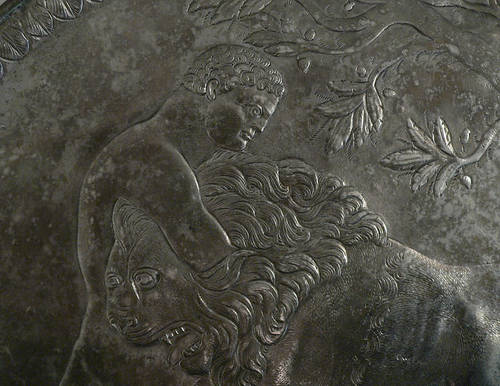 Hercules and the Nemean Lionby Clio20 (CC BY-SA) 2. To kill the monster known as the Hydra who had nine venemous heads and, when one was cut off, two more would grow in its place. With his nephew Iolaus, Hercules cut off the heads and Iolaus then seared the necks with a torch to prevent them growing back. Hercules then dipped his arrows in the Hydra's blood for future use; since it was so venomous, it killed quickly. Because he had help in this labor, Eurystheus would not count it as one of the ten and assigned another.
 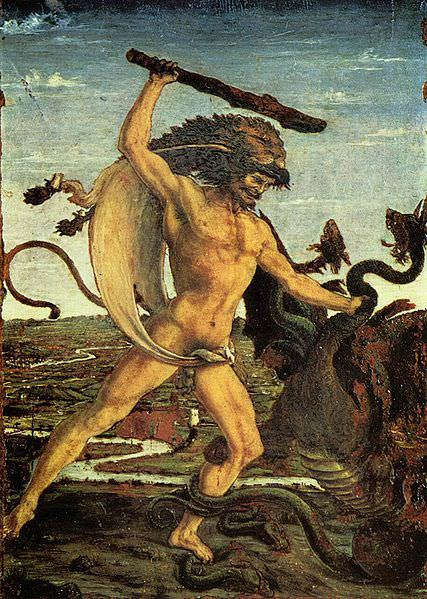 Hercules and the Hydraby The Yorck Project (Public Domain) 3. To capture the Cerynitian Hind who was sacred to the goddess Artemis. Hercules spent over a year trying to catch the deer with the golden antlers alive and finally brought it down with an arrow to the hoof. Even so, Artemis refused to allow him to take the deer - and would have killed him for hunting it - until she heard the story of his labors and let him go. 4. To capture the Erymanthian Boar. This labor took Hercules to the land of the Centaurs, and the wine he had been given to attract the boar drew the centaurs to him. They attacked him and he had to kill many of them but brought the boar back alive to Eurystheus. It was during this labor that he took part in the adventure with the hero Jason and his Argonauts. 5. Cleaning the Stables of Augeius in a day. Eurystheus felt this side-adventure with the Argonauts was an unnecessary luxury on Hercules' part and so devised an impossible task for his next labor. The stables of King Augeius were immense and his herd vast, and there seemed to be no way for anyone to clean them in a month, let alone a day. Hercules said he would do it but made Augeius promise him a tenth of the herd if he succeeded. Augeius agreed since he knew he could not lose, but Hercules diverted two rivers to flow through the stables and clean them completely. Augeius then refused to honor the deal he had made. Hercules felt cheated and swore he would return and kill Augeius once he had completed his labors for Eurystheus. Eurystheus, however, told him he could receive no payment for his labors and that, by trying to profit, he had disqualified that labor and would have to do another to make up for it.
6. To drive away the Stymphalian Birds who were ravaging the countryside. He accomplished this with a rattle given to him by Athena. The rattle startled the birds who flew away, and Hercules shot them down with his arrows in flight.
7. To bring back the Cretan Bull from Knossos. The bull belonged to King Minos of Crete and was sacred to the god of the seas, Poseidon; accordingly, it could walk on water. Minos no longer wanted the bull because his wife had fallen in love with it and, in fact, had become pregnant by it (giving birth to the Minotaur), and so Minos happily gave the bull to Hercules who rode it across the sea from Crete to Athens and brought it to Eurystheus. The bull was then released and would cause further trouble throughout Attica until it was finally killed by Theseus.
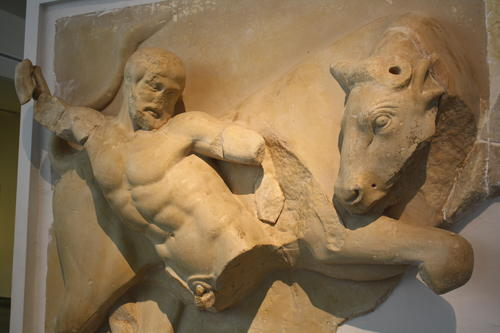 Hercules & The Cretan Bullby Mark Cartwright (CC BY-NC-SA) 8. To bring back the Mares of Diomedes. Diomedes was a Thracian king who fed his horses on a steady diet of human flesh so that no one could come near them. Hercules fed Diomedes to the horses and, when they were full, brought them back to Eurystheus. It was during this labor, either going to or coming from Diomedes' palace, that Hercules stopped to visit his old friend Admetus whose wife Alcestis had recently died. Hercules wrestled death for the soul of Alcestis and returned her to her husband. 9. To bring back Hippolyte's Girdle. Hippolyte was the queen of the Amazons, and her belt (girdle) was a symbol of her right to rule. The Amazons originally welcomed Hercules but Hera, disguised as one of them, spread a rumor that Hercules had come to kidnap the queen and enslave them. The women attacked Hercules and Hippolyte was killed in the fight; Hercules then took her belt and left. In another version of this labor, however, no one dies; Hercules kidnaps Hippolyte's sister and ransoms her for the belt and then leaves peacefully. On his return voyage he has many other side-adventures, which further enrage Eurystheus, but he accepts the girdle as a legitimate labor. 10. To bring back the cattle of Geryon, king of Cadiz. Hercules had many side-adventures on this labor, including inadvertently building the Pillars of Hercules at Gibraltar and threatening to shoot the sun with his arrows for making him too hot. When he finally reached Cadiz (Spain), he had many problems rounding up the cattle, including having to chase down a bull (the herd had to be complete in order to be accepted for the labor). Bringing the cattle back to Greece, Hera sent gadflies to sting the beasts and scattered them, so Hercules had to round them up again. Then the princess Celtine saw Hercules and fell in love with him. She hid the cattle and would not divulge their whereabouts unless he had sex with her. This he did and so became the father of Celtus, progenitor of the Celts. He finally brought the cattle back to Eurystheus who accepted the labor as legitimate.
11. To bring back the Golden Apples of Hesperides. En route to the sacred grove where the apples grew, Hercules found Prometheus bound to his rock and set him free. Prometheus was grateful and told him that the apples were guarded by a dragon named Ladon who could not be conquered, and so Hercules should try to get the titan Atlas, who held up the earth and heavens on his shoulders, to get the apples for him. When Hercules reached the grove, Atlas agreed to help, but Hercules would have to shoulder the weight of the world while Atlas went to get the apples. Hercules accepted the load and Atlas got the apples. When he returned, however, Atlas did not want to take the weight back and was going to leave Hercules in his place. Hercules cheerfully agreed to stay and hold up the universe but asked Atlas if he could take the weight again for just one moment so that he could adjust his cloak to cushion his shoulders. Atlas took back the universe and Hercules picked up the apples and left.
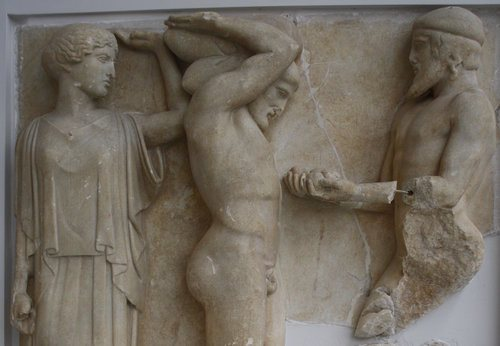 Hercules and Atlasby Mark Cartwright (CC BY-NC-SA) 12. To bring back Cerberus, the guard dog of the underworld. For the last labor, Eurystheus decided on something he knew would be impossible: to bring back, alive, the three-headed dog who guarded the entrance to Hades. Before he could enter the underworld, Hercules had to become initiated in the Eleusinian Mysteries at the sacred city of Eleusis. He then journeyed to Hades, where he had further adventures in the underworld such as freeing his cousin Theseus from the Chair of Forgetfulness where he had been bound. He also spoke with the hero Meleager, with whom he had journeyed with the Argonauts, who told him that, when he returned to earth, he should marry Meleager's sister Deianira. Hercules was allowed by Hades to take Cerberus provided he did not hurt the dog. He wrestled Cerberus into submission and brought him back to Eurystheus who was so terrified of the animal that he told Hercules all the labors were done and to bring the dog back to where he'd found it.
NOW SOME IMPORTANT NOTES ABOUT THE HERCULES WE SAW IN RICK RIODAN'S BOOKS
| “ | You understand nothing. My first family: dead. My life wasted on ridiculous quests. My second wife dead, after being tricked into poisoning me and leaving me to a painful demise. And my compensation? I got to become a minor god. Immortal, so I can never forget my pain. Stuck here as a gatekeeper, a doorman, a… a butler for the Olympians. No, you don’t understand. | ” |
| –Hercules to Jason Grace, in The Mark of Athena | ||
GUYS IF YOU WANT TO KNOW MORE ABOUT THE GODS IN PERCY JACKSONS BOOKS.
THATS ALL FOR TODAY HOPE U ENJOYED IT..